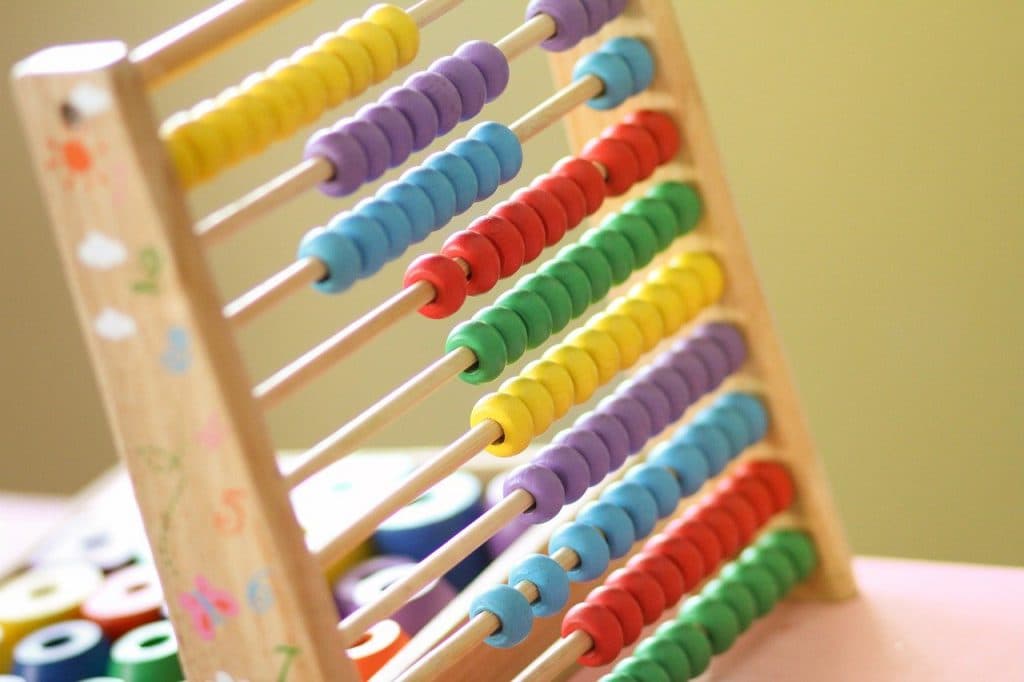
Math anxiety usually starts the same way: worksheets, a ticking timer, and red pen. Games run on the exact same skills, except nobody's stomach hurts.
These are built for grades 2 through 5, and almost none of them need more than a deck of cards or a pair of dice.
- Time needed
- 10-20 minutes per game
- Best age range
- Grades 2-5 (ages 7-11)
- Adult supervision
- No. Kids can play independently or with a family member
- What kids will learn
- number sense, mental math, fractions, and estimation
Number War
A card game that builds number sense fast.
How to Play
- Pull the face cards out, or give them values.
- Deal the whole deck out evenly.
- Both players flip one card.
- Higher card takes both.
- Want multiplication? Flip two cards each and multiply.
Why It Works
101 and Out
A dice game about mental addition and knowing when to stop.
How to Play
- Start at 0.
- Roll two dice.
- Add them together, or use one as tens and one as ones.
- Get as close to 101 as you dare without going over.
Why It Works
Fraction Pizza
A game where fractions turn into something you can hold.
How to Play
- Cut paper circles into fraction slices.
- Take turns drawing a slice.
- Race to complete exactly one whole circle.
- If a slice would push you over, you skip.
Why It Works
Target Number
A mental math puzzle with more than one right path.
How to Play
- Pick five digits.
- Pick a target number.
- Use any operations you want to hit it.
- Compare answers and see who found a shortcut.
Why It Works
Twenty Questions Math Edition
A guessing game that sneaks in math vocabulary.
How to Play
- Think of a number and keep it secret.
- The other player asks yes or no math questions.
- Try to nail it in as few questions as possible.
Why It Works
Estimation Jar
A weekly guessing challenge that basically runs itself.
How to Play
- Fill a jar with small objects.
- Everyone writes down a guess.
- Count them together later in the week.
- Closest guess wins.
Why It Works
A Note on Timed Practice
Fluency comes from seeing the same math over and over somewhere that getting it wrong costs nothing. Games do that. Timed tests do the opposite.
Want more? A bunch of these games and other activities live on our games page.
- Start with the game your kid already likes the look of
- Play with them, not at them
- Let them win a few early on
- Ask what they think before you correct anything
- Stop while they still want one more round
For Parents
“My daughter asked to play 101 and Out three nights in a row. I never told her it was math practice.”