Science
Baking Soda Volcano
Build a mini volcano and trigger a bubbly eruption with a classic acid-and-base reaction.
Easy · 1 hour
Introduction
Volcanoes are some of the most dramatic natural wonders on Earth, and now you can build one on your own table.
This project is exciting because you get to mix ingredients, create an eruption, and watch chemistry in action.
The Why
Baking soda is a base and vinegar is an acid. When they mix, they make a new gas called carbon dioxide, and that gas creates bubbling foam that pours out like an erupting volcano.
The reaction in full
The eruption is actually two steps happening very fast.
Step 1: Acid-base exchange
Acetic acid (vinegar) meets sodium bicarbonate (baking soda). They trade parts and produce sodium acetate and carbonic acid.
Step 2: Decomposition
Carbonic acid is unstable, so it immediately breaks apart into water and carbon dioxide gas. That is the CO₂ you see rushing out as foam.
NaHCO₃ + CH₃COOH → CH₃COONa + H₂O + CO₂
Step-by-Step Instructions
- 1
Place your bottle in the middle of a tray so your mess stays in one spot.
- 2
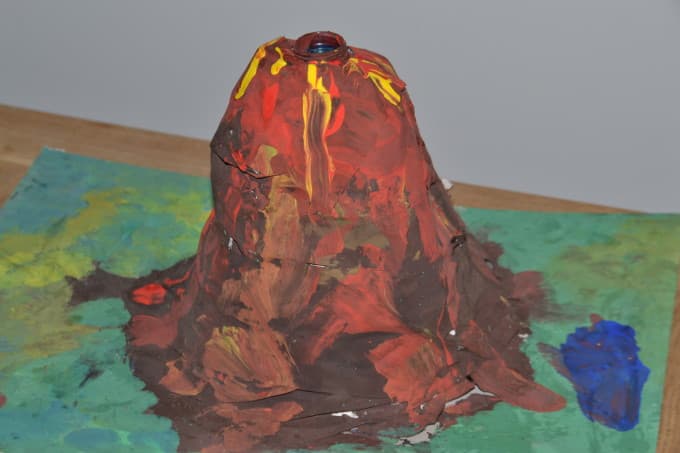
Build a volcano shape around the bottle with clay, play dough, or foil, but keep the bottle opening clear.
- 3
Put 2 or 3 spoonfuls of baking soda into the bottle.
- 4
Add a squirt of dish soap and a few drops of food coloring.
- 5
Pour vinegar into the bottle and watch the foamy lava rise up and spill over.
- 6
Observe the bubbles closely and talk about the gas being made inside the bottle.
- 7
Rinse the tray and try again with different amounts to see how the eruption changes.
Science vocabulary
- Nucleation
- When dissolved gas finds a rough surface to escape from. The tiny bumps on Mentos candy do the same thing: they give gas many escape points at once.
- Carbon dioxide (CO₂)
- The gas produced when baking soda and vinegar react. It expands rapidly and pushes the liquid upward.
- Surface tension
- Dish soap lowers the surface tension of the liquid, which lets the CO₂ form more stable bubbles. That is why the foam is thick instead of thin and quick.
- Endothermic reaction
- The mixture often feels slightly cooler after the reaction. That is because the chemical process absorbs heat from the surroundings.
Turn It Into a Science Fair Project
A volcano demo becomes a stronger science experiment when you change one variable at a time, measure the result, and repeat each test.
- Hypothesis
- If we add more vinegar while keeping baking soda the same, then the eruption height may increase until the baking soda runs out.
- Independent variable
- The one thing you change: vinegar amount, baking soda amount, soap amount, or bottle shape.
- Dependent variable
- What you measure: eruption height, foam overflow distance, or reaction time.
- Controlled variables
- Keep the bottle, tray, baking soda type, vinegar type, and measuring method the same.
| Trial | Vinegar amount | Baking soda amount | Eruption height |
|---|---|---|---|
| 1 | _____ | _____ | _____ |
| 2 | _____ | _____ | _____ |
| 3 | _____ | _____ | _____ |