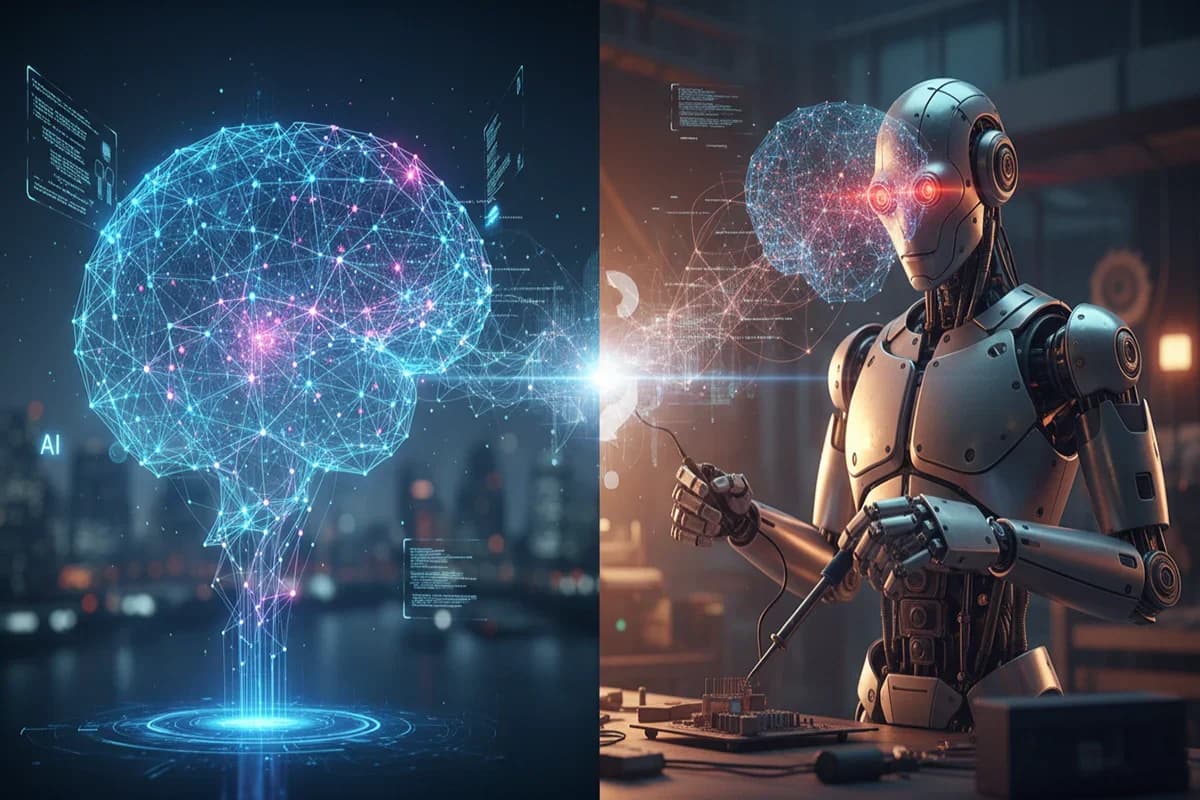
Movies did this to us. Robots stroll around, hold conversations, make plans, occasionally decide to take over the planet. So it is completely reasonable to assume robot and AI mean the same thing.
They do not. A robot is a machine that does things in the physical world. AI is software that recognizes patterns and makes predictions. They team up sometimes. But plenty of robots have no AI at all, and most AI has never had a body in its life.
What Is a Robot?
A robot is a machine that senses, moves, or gets a job done. Some look vaguely human. Most look nothing like us. You have probably been around several today:
- A robotic vacuum
- A factory arm building cars
- A drone
- A Mars rover
- A toy robot
- A machine used in surgery
Robots come with physical hardware: motors, wheels, arms, cameras, sensors, grippers. That is the whole point. A robot touches the real world.
What Is AI?
AI stands for artificial intelligence, and it means software that pulls off tasks we used to think required a mind. Spotting patterns, predicting what comes next, writing text, sorting images, translating languages, deciding which video you see next.
None of that needs a body. A chatbot lives entirely inside software. It can write you an essay about pencils and it cannot pick up a pencil, not unless someone wires it into a robot. AI is the deciding part. The robot is the doing part.
What Are Sensors and Motors?
Sensors are how a machine notices anything. You get sight, hearing, and touch. A robot gets a camera to see, a microphone to hear, a bump sensor to feel contact, a distance sensor to stop before the wall, a thermometer to check heat.
Motors are how it moves. Spin a wheel, lift an arm, open a claw, rotate a joint. If sensors are the senses, motors are the muscles. And like muscles, they decide nothing on their own. Somebody has to tell them what to do.
A Robot Without AI
Plenty of robots run with basically no AI. Picture a little bot chasing a strip of black tape across the floor. Light sensor underneath. Sees the line, drives forward. Drifts off, steers back.
It looks clever. It is not. It is following two rules with sensors and motors, and it will follow them forever without ever learning a thing.
AI Without a Robot
Flip it around. An AI helps you write a poem. It has words, and that is it. No wheels, no arms, no camera. It cannot cross the room, stack a block, or hand you a water bottle.
That is AI with no robot attached. Brilliant with information, completely stuck in the computer.
A Robot With AI
Then there is the combination, and a self-driving car is the obvious one. Cameras and sensors watch the road, the signs, the lanes, the cars, the person about to step off the curb. AI turns all that into a decision about what to do in the next half second.
Try This
Look around wherever you are right now. Find something that is a robot. Find something that uses AI. Find something that is just a computer doing computer things.
- A calculator is a computer tool, not AI.
- A robot vacuum is a robot, and a fairly simple one.
- A voice assistant is AI with no body.
- A printer is a machine with moving parts, but nobody really calls it a robot.
Sorting things into those buckets is exactly how engineers think about technology, and it gets easier fast.
The Big Idea
A robot and an AI are two different things. One is a machine that moves through the physical world. The other is software that finds patterns and makes decisions. Put them together and you get something impressive. Apart, they are still each useful.
Keep Exploring
How Do Video Games Use AI?