Engineering
Balloon-Powered Car
Build a car that runs on air and discover how Newton's Third Law of Motion turns a simple balloon into a powerful engine.
Easy · 1-2 hours
Introduction
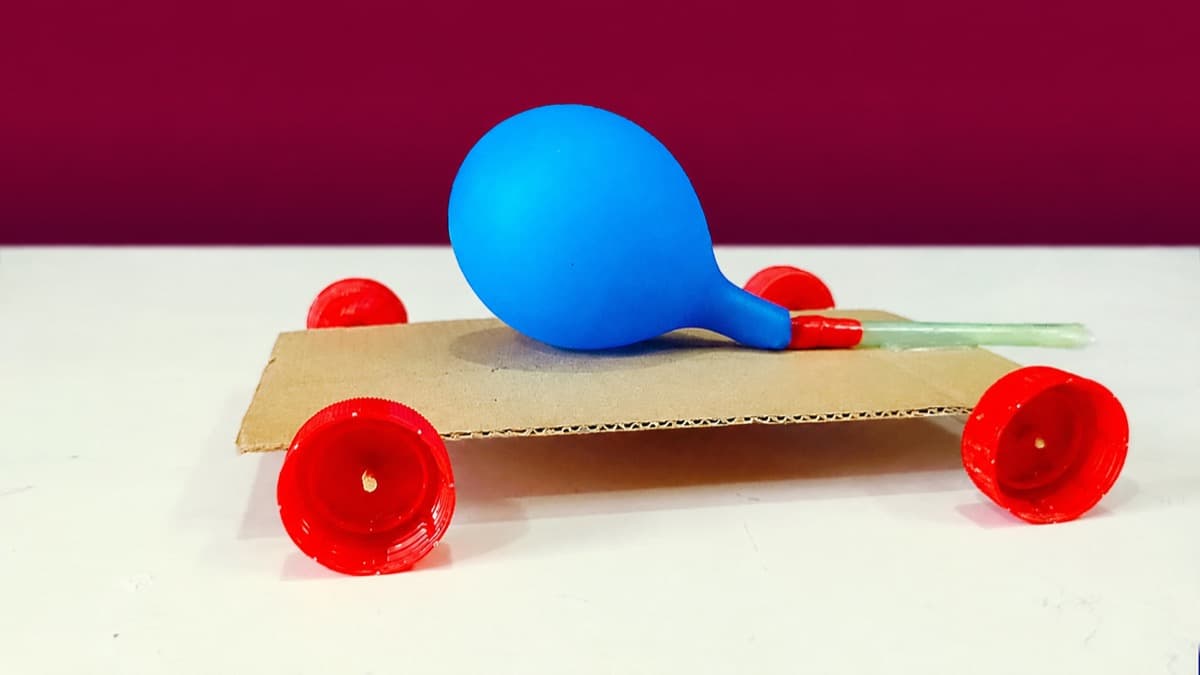
A balloon-powered car uses the air rushing out of a balloon to push itself forward. When air escapes backward through a straw, the car moves forward. That is Newton's Third Law of Motion at work.
You can build one from everyday recycled materials and then test how small changes in design, like wheel size, car weight, or how tightly the balloon is sealed, make it travel farther.
What You'll Learn
Newton's Third Law of Motion
Potential and kinetic energy
Basic engineering design
How small changes in wheels, axles, weight, and airflow affect performance
How It Works
When the balloon is inflated, it stores potential energy in the stretched rubber and compressed air. When the balloon is released, the air escapes backward through the straw. That backward push creates an equal and opposite reaction, pushing the car forward. The stored potential energy becomes kinetic energy, which is the energy of motion.
Step-by-Step Instructions
- 1
Tape straw pieces to the underside of the car body to hold the axles.
- 2
Slide skewers or straws through the axle holders.
- 3
Attach bottle caps to the ends of each axle to create wheels.
- 4
Insert a straw into the balloon and tape it tightly so no air leaks out.
- 5
Tape the balloon-and-straw engine to the top of the car with the straw pointing off the back.
- 6
Blow up the balloon, pinch the straw, place the car on a flat surface, and release it.