Light & Optics
Build a Spectroscope from a CD
Build a real spectroscope from a cereal box and a scrap CD, then find out which lamps give you a smooth rainbow and which give you a handful of separate bright lines.
Medium · 1 hour
Introduction
A rainbow looks continuous: every color running into the next with nothing missing. Sunlight really is like that. Most of the lamps in your house are not, and you cannot tell by looking at them.
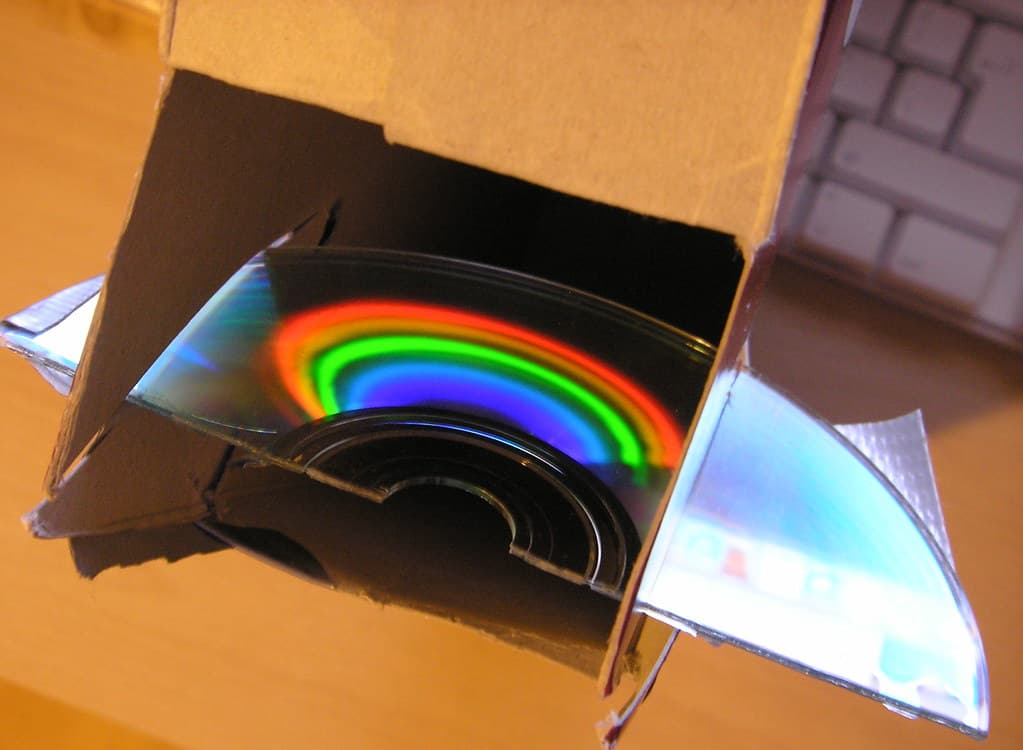
The grooves on a CD are packed closer together than the wavelength of light, which makes the disc a diffraction grating, which makes it the working part of a genuine scientific instrument. The rest of the instrument is a cereal box.
The Why
A hot solid glows in every color at once, because its atoms are crowded together and jostling, and that is the smooth rainbow you get from sunlight or an old filament bulb. A thin glowing gas does something completely different: a few sharp separate colors, and nothing at all in between. That happens because an electron inside an atom cannot sit just anywhere. It can only occupy certain fixed energy levels, like rungs on a ladder with no space between them, and when it drops from one rung to another it releases a photon whose color is set exactly by the size of that gap. Those separated lines are that rule made visible, and they are one of the results that forced physicists to invent quantum mechanics in the first place.
Step-by-Step Instructions
- 1
Tape the top of the cereal box shut so no light gets in, and line the inside with black paper if you can.
- 2
Make a narrow slit in one end, about 1 mm wide and 3 cm tall. Two straight card edges taped a millimeter apart give a much cleaner slit than a knife cut does.
- 3
With an adult, cut a rough wedge out of the disc. On a DVD, split the two halves apart first and keep the layer that still has the rainbow sheen.
- 4
Cut a viewing hole about 2 cm across in the opposite end of the box, low down.
- 5
Tape the disc piece inside the box below the viewing hole, tilted at roughly 60 degrees, so that looking through the hole means looking at the disc surface and seeing the slit reflected in it.
- 6
Point the slit at a white wall lit by daylight and look through the viewing hole. Adjust the tilt until a band of color appears off to one side, then tape the disc down.
- 7
Now look at four sources in turn, never the sun itself: daylight on a wall, an old filament or halogen bulb, a fluorescent tube or energy-saving bulb, and a white LED. Sketch what you see for each.
Spectrum Sketches
One row per light source. Draw what you see rather than describing it, and note whether the colors run into each other or stand apart.
| Light source | Continuous or separate lines? | Colors you can pick out | Anything missing? |
|---|---|---|---|
| Row 1, Light source | Row 1, Continuous or separate lines? | Row 1, Colors you can pick out | Row 1, Anything missing? |
| Row 2, Light source | Row 2, Continuous or separate lines? | Row 2, Colors you can pick out | Row 2, Anything missing? |
| Row 3, Light source | Row 3, Continuous or separate lines? | Row 3, Colors you can pick out | Row 3, Anything missing? |
| Row 4, Light source | Row 4, Continuous or separate lines? | Row 4, Colors you can pick out | Row 4, Anything missing? |
| Row 5, Light source | Row 5, Continuous or separate lines? | Row 5, Colors you can pick out | Row 5, Anything missing? |
| Row 6, Light source | Row 6, Continuous or separate lines? | Row 6, Colors you can pick out | Row 6, Anything missing? |
The last column is the most useful one. A gap where a color should be tells you something was never emitted at all, and that is as much information as a bright line is.