Light & Optics
The Double Slit on Your Bedroom Wall
Cut two slits into black paper, send a laser through them, and get the striped pattern that convinced physicists light is a wave. Then use those stripes to measure a gap far too small to put a ruler on.
Hard · 2 hours
Introduction
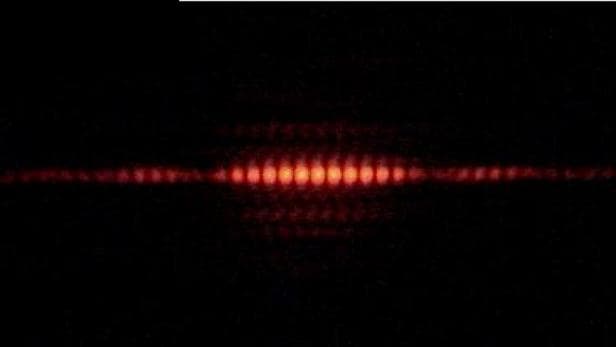
Two slits, one laser, one wall. If light were simply a stream of tiny bullets you would expect two bright stripes, one behind each slit. You do not get two. You get a whole row of them, evenly spaced, with dark gaps in between.
This is the most repeated experiment in physics, and the version on your bedroom wall is the same experiment. The hard part is not the physics. It is cutting two slits close enough together.
The Why
Waves leaving the two slits arrive at each point on the wall having travelled slightly different distances. Where that difference is a whole number of wavelengths the two line up and add together into a bright stripe; where it is half a wavelength they cancel and leave darkness. That is interference, and only waves do it. The spacing of the stripes is tied to the wavelength of the light and the gap between the slits by one simple relationship, which means you can run it backwards: measure stripes that are millimeters apart, and calculate a slit gap far too small to measure directly.
Step-by-Step Instructions
- 1
Tape the black paper flat across the window in the card so it is smooth and taut. Hold it up to a lamp first: if light comes through the paper itself, the stripes will be washed out and you need something more opaque.
- 2
With an adult, make two straight parallel cuts in the paper about 1 cm long. Lay the blade against a ruler and drag it once. Get the cuts as close together as you possibly can, well under a millimeter apart.
- 3
Set the card so the laser shines through both slits at once and continues to a wall at least 3 meters away. Tape everything down, because a card that shifts ruins the measurement.
- 4
Darken the room. The adult aims the laser through the slits. Adjust until you see a row of dots or stripes rather than a single blob. One blob means either your slits are too far apart or the beam is only passing through one of them.
- 5
Measure the distance from the paper to the wall in meters and write it down. Call it L.
- 6
On the wall, measure across as many stripes as you can at once, center to center, then divide by the number of gaps you counted. That average is your fringe spacing, y. Measuring several stripes at once is what makes this accurate.
- 7
Calculate the slit separation: d equals the wavelength times L, divided by y. A red pointer is about 650 nanometers, which is 0.000000650 meters. Your answer should land somewhere around a few tenths of a millimeter.
Watch this first
Fringe Measurements
Measure the same pattern three times without moving anything. If your three answers disagree, the problem is the measurement rather than the physics.
| Trial | Distance to wall L (m) | Stripes measured across | Total width (mm) | Fringe spacing y (mm) | Calculated d (mm) |
|---|---|---|---|---|---|
| Row 1, Trial | Row 1, Distance to wall L (m) | Row 1, Stripes measured across | Row 1, Total width (mm) | Row 1, Fringe spacing y (mm) | Row 1, Calculated d (mm) |
| Row 2, Trial | Row 2, Distance to wall L (m) | Row 2, Stripes measured across | Row 2, Total width (mm) | Row 2, Fringe spacing y (mm) | Row 2, Calculated d (mm) |
| Row 3, Trial | Row 3, Distance to wall L (m) | Row 3, Stripes measured across | Row 3, Total width (mm) | Row 3, Fringe spacing y (mm) | Row 3, Calculated d (mm) |
d equals 0.000000650 times L, divided by y, with y converted into meters first. A slip of a thousand between millimeters and meters is the mistake almost everybody makes here.