Light & Optics
Bending Light Down a Stream of Water
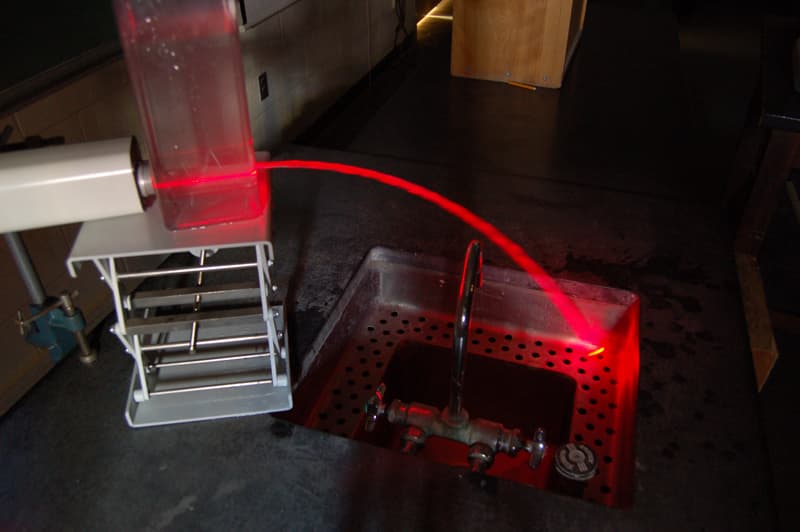
Send a beam of light down a falling stream of water and watch it follow the curve, which is exactly the trick that carries the internet across the ocean floor.
Medium · 1 hour
Introduction
Light travels in straight lines. That is the whole basis of the camera obscura, and it is true. So how does a signal get down a hair-thin glass fiber that is coiled up under the Atlantic?
The answer is that light can be trapped. Once you have watched it happen inside a stream of water pouring out of a bottle, the cable under the ocean stops being mysterious.
The Why
When light already inside water arrives at the surface at a shallow enough angle, it does not get out. It reflects back in, completely, every time, which is why this is called total internal reflection. For water the cutoff sits at about 49 degrees; strike the surface at a shallower angle than that and the light stays inside. In a curving stream the light keeps meeting the edge past that cutoff, so it keeps bouncing along and follows the curve down. An optical fiber is this same trick made permanent in glass.
Step-by-Step Instructions
- 1
An adult makes one clean hole about 5 mm across in the side of the bottle, near the bottom. On thin plastic a heated nail works better than a drill.
- 2
Cover the hole with a finger or a piece of tape, fill the bottle with water, and stand it at the edge of the sink so the stream will arc down into the basin.
- 3
Turn the lights off. The adult holds the laser flat against the side of the bottle directly opposite the hole, aiming straight across so the beam travels through the water and out through the hole.
- 4
Release the stream. Watch where the water lands rather than watching the bottle: you should see a bright spot riding down inside the falling stream and lighting up the point where it hits.
- 5
Nudge the aim until the light stays in the stream as long as possible. When it is right the whole curve glows faintly and the landing point is bright.
- 6
Now break it on purpose. Put a finger into the stream partway down and watch the light stop there. The bounce only works while the surface stays smooth and unbroken.
- 7
Change the curve by raising and lowering the bottle so the stream falls more steeply or more gently. Record which shape carries the light furthest before it leaks out.
How Far Did the Light Go
One row per attempt. Measure from the hole to the point where the light visibly leaves the stream.
| Attempt | What you changed | Stream shape | Distance light stayed in (cm) |
|---|---|---|---|
| Row 1, Attempt | Row 1, What you changed | Row 1, Stream shape | Row 1, Distance light stayed in (cm) |
| Row 2, Attempt | Row 2, What you changed | Row 2, Stream shape | Row 2, Distance light stayed in (cm) |
| Row 3, Attempt | Row 3, What you changed | Row 3, Stream shape | Row 3, Distance light stayed in (cm) |
| Row 4, Attempt | Row 4, What you changed | Row 4, Stream shape | Row 4, Distance light stayed in (cm) |
| Row 5, Attempt | Row 5, What you changed | Row 5, Stream shape | Row 5, Distance light stayed in (cm) |
| Row 6, Attempt | Row 6, What you changed | Row 6, Stream shape | Row 6, Distance light stayed in (cm) |
If you cannot see where the light leaves, look for where the stream stops being one smooth rope and becomes separate drops. It is nearly always the same place.