Robotics
Rover Wheels vs. Sand
Build four different wheels from cardboard and bottle caps, run the same chassis over the same tray of sand and gravel, and measure which design actually travels furthest.
Medium · 2 hours
Introduction
The hardest part of driving on Mars is not the driving. It is that the ground is loose, and a wheel that works perfectly on a smooth floor can dig itself into a hole and stop.
You do not need a robotics kit to work on that problem. You need a tray of sand, one simple rolling chassis, and four sets of wheels you have made different on purpose.
The Why
Everything except the wheels has to stay the same or you learn nothing: same chassis, same ramp, same sand, same starting point. That is called controlling your variables, and it is what lets you say the wheels caused the difference. Real rover teams do exactly this, running wheel designs across test beds here on Earth, because nobody can be sent to Mars to fix a wheel that turned out wrong.
Step-by-Step Instructions
- 1
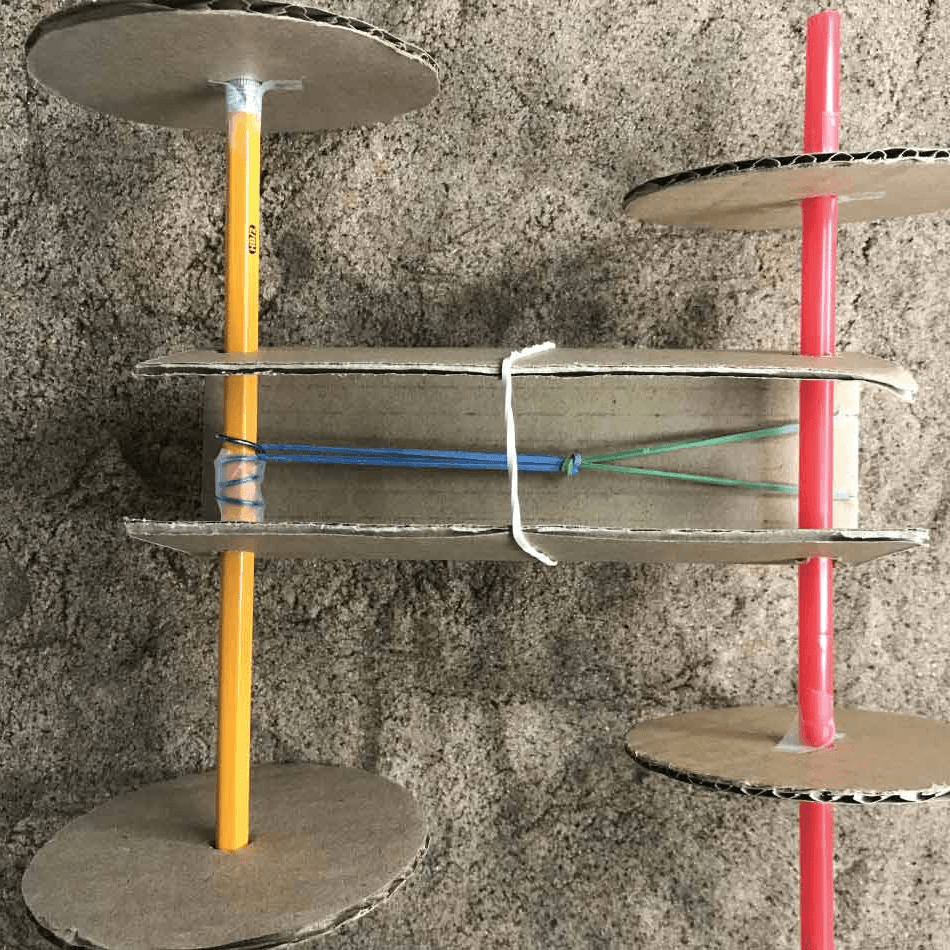
Build one simple chassis: a rectangle of cardboard with two straw axle holders taped underneath. This is the only chassis you get, so make it sturdy, and use it for every single run.
- 2
Fill the tray with sand or gravel about two centimeters deep and smooth it flat. Smooth it flat again before every run.
- 3
Set a ramp at one end so every run starts with exactly the same push. Mark the release point and never move it.
- 4
Make four sets of wheels that each differ in one obvious way: narrow against wide, smooth against treaded, small against large diameter. Write down what makes each set different.
- 5
Run set one three times, smoothing the sand between runs. Measure from the end of the ramp to the front of the chassis and write down all three distances.
- 6
Repeat for all four sets, three runs each. Twelve runs in total, with no changing the ramp or the chassis in between.
- 7
Average the three distances for each set and compare. Then look at the tracks left in the sand, because the wheels that dug in tell you as much as the wheels that did not.
Wheel Test Results
Three runs per wheel set, twelve runs in total. Smooth the sand flat before every single run.
| Wheel set | What makes it different | Run 1 (cm) | Run 2 (cm) | Run 3 (cm) | Average |
|---|---|---|---|---|---|
| Row 1, Wheel set | Row 1, What makes it different | Row 1, Run 1 (cm) | Row 1, Run 2 (cm) | Row 1, Run 3 (cm) | Row 1, Average |
| Row 2, Wheel set | Row 2, What makes it different | Row 2, Run 1 (cm) | Row 2, Run 2 (cm) | Row 2, Run 3 (cm) | Row 2, Average |
| Row 3, Wheel set | Row 3, What makes it different | Row 3, Run 1 (cm) | Row 3, Run 2 (cm) | Row 3, Run 3 (cm) | Row 3, Average |
| Row 4, Wheel set | Row 4, What makes it different | Row 4, Run 1 (cm) | Row 4, Run 2 (cm) | Row 4, Run 3 (cm) | Row 4, Average |
If one run comes out wildly different from the other two, do not delete it. Write down what went wrong beside it, because that is usually where the interesting failure is hiding.