Engineering
Rubber Band-Powered Car
A simple DIY car that moves without electricity or batteries, just the stored energy of a twisted rubber band powering the wheels and axle forward.
Easy · 1-2 hours
Introduction
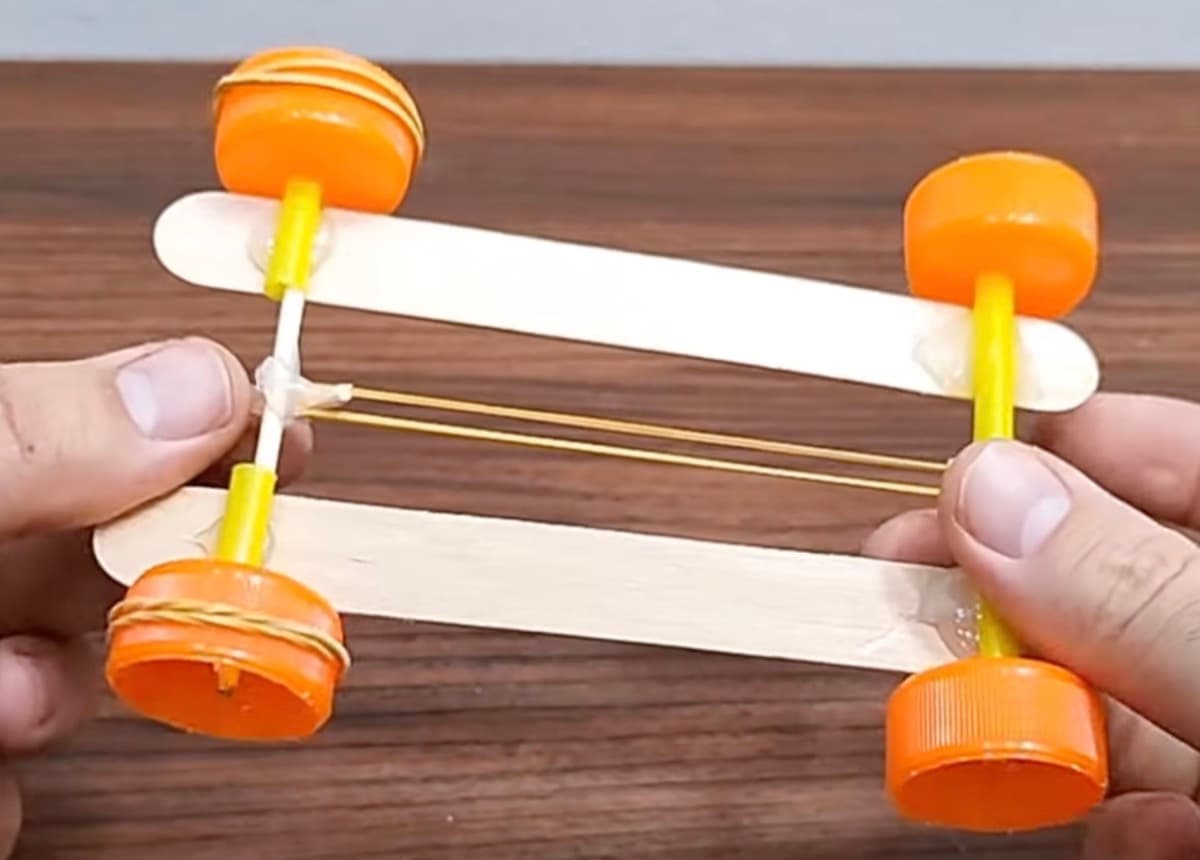
A rubber band-powered car is one of the most satisfying builds because you do all the work, wind it up, set it down, and then watch physics take over.
You can build one from everyday materials and then start tweaking: change the rubber band, the wheels, or the car weight, and see exactly how each change affects how far it travels.
What You'll Learn
How stored energy can create motion
Potential and kinetic energy
How wheels and axles work together
Friction and motion on flat surfaces
How design changes affect speed and distance
Beginner engineering and testing skills
How It Works
The rubber band stores energy when it is twisted or wound up. When the car is released, the rubber band untwists and transfers that stored energy into the wheels or axle. This changes potential energy into kinetic energy, which is the energy of motion. The car moves best on a smooth, flat surface, and students can improve the design by changing the rubber band, wheels, car length, or car weight.
Step-by-Step Instructions
- 1
Build the main body of the car using cardboard, foam board, or another lightweight material.
- 2
Attach straw pieces to the bottom of the car body to hold the axles in place.
- 3
Slide skewers, pencils, or straws through the axle holders.
- 4
Attach the wheels carefully to each end of the axles, making sure they spin smoothly.
- 5
Connect one end of the rubber band to the car body and the other end to the rear axle.
- 6
Twist or wind the rubber band by turning the rear wheels or axle backward.
- 7
Place the car on a smooth, flat surface.
- 8
Release the car and watch it move forward using rubber band power.
Physics vocabulary
- Potential energy
- Energy stored in an object because of its position or shape. A wound-up rubber band holds potential energy in its twisted form, ready to be released.
- Kinetic energy
- The energy of motion. When the rubber band releases and the wheels spin, the stored potential energy becomes kinetic energy that moves the car.
- Axle
- A rod that passes through the center of a wheel and connects both sides. When the rubber band spins the axle, the wheels attached to it spin too.
- Friction
- A force that slows objects down when surfaces rub together. Smooth wheels on a smooth floor have less friction, which helps the car travel farther.