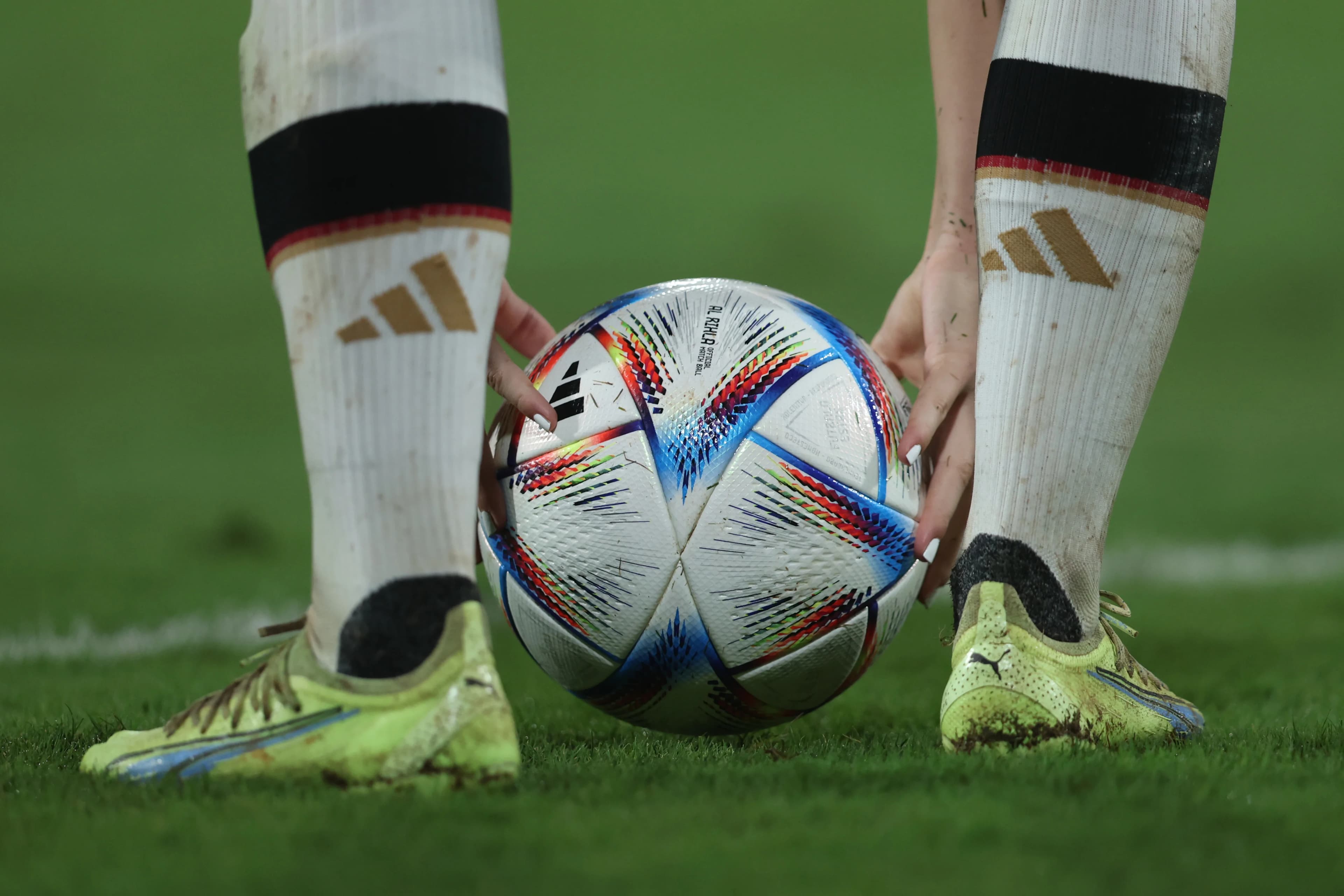
The ball sitting in your garage is a more serious piece of engineering than it looks. Old soccer balls were leather, and leather drinks water, so by the second half of a rainy match players were basically kicking a wet brick. Today's match balls are built out of materials science, panel geometry, and factory tech that did not exist twenty years ago.
The 4-Layer Anatomy
Cut a real match ball open and you find four layers, each one there for a reason:
- Bladder: the balloon at the center, usually butyl or latex rubber, holding the air. Butyl keeps pressure longer. Latex feels softer and bounces better. Manufacturers pick their poison.
- Lining: layers of woven polyester and cotton wrapped around the bladder. This is what keeps the ball round after ten thousand kicks instead of slowly turning into an egg.
- Foam cushioning: a layer of polyurethane or EVA foam under the outer shell. It squashes on impact and springs back, firing more of your energy into the shot.
- Casing: the synthetic leather outside. It refuses to soak up water, so the ball weighs the same in minute 90 as it did in minute 1, and its texture is engineered to grip the air.
Panel Design and Aerodynamics
The biggest change you can actually see is the panels. That classic 32-panel ball with black pentagons had seams everywhere, and every seam is drag. Modern match balls get away with 6 to 8 panels, which cuts the total seam length way down.
They are not even stitched anymore. Heat and high-frequency glue bond the panels into something nearly seamless and completely watertight. Engineers model the airflow using the same simulation software used to design aircraft. And those little bumps and grooves on the surface? Not decoration. They control the layer of air clinging to the ball, which is what keeps a hard shot flying straight instead of knuckling all over the place.
Dynamic Balance and the Magnus Effect
Every match ball has to pass a dynamic balance test, which means its weight is spread so evenly that it spins without wobbling. Get that wrong and the ball flutters unpredictably, which players hate and manufacturers get roasted for.
Get it right and you unlock the Magnus effect. Strike the ball off-center and it spins. One side of that spinning surface drags along with the air, the other side fights against it. That imbalance creates a real sideways force that bends the ball's path mid-flight. Every free kick that curls around a wall is that force doing its thing.
The Magnus Effect in Action
Embedded Technology
Top-tier match balls are not just leather and air anymore. Some now carry a sensor suspended inside the ball on its own little frame, tracking movement in three dimensions and reporting back 500 times per second. Where the ball is, how fast it is going, the exact instant a boot touched it.
That feed is what powers semi-automated offside calls and goal-line technology, which can tell you within milliseconds whether the whole ball crossed the line. The ball is now part of the officiating crew.
Final Thought
A soccer ball is not just a thing you kick. It is a layered system where materials science, fluid dynamics, and sensors all have to cooperate. Every unbelievable shot you have ever seen started with somebody engineering the ball.