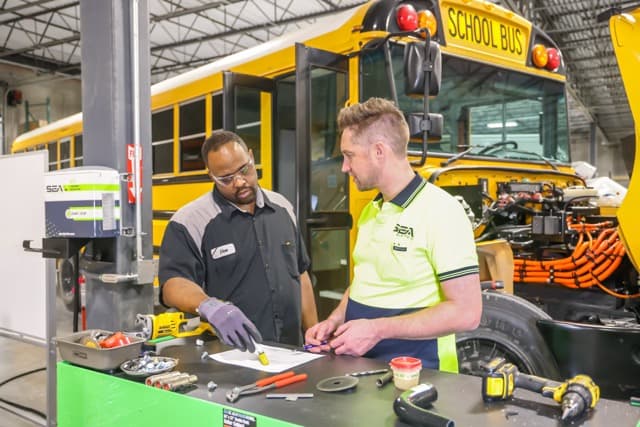
A school bus looks about as simple as a vehicle gets. Big yellow box, rows of seats, flashing lights, an engine you can hear from two streets away. But almost every piece of that bus is an answer to one question somebody had to solve: how do you move a crowd of kids and get every single one of them home safe?
Once you know what to look for, the bus stops being boring. Let's take it apart.
Why Are School Buses Yellow?
Nobody picked that yellow because it looked nice. It was chosen because your eye catches it in early morning light, in flat afternoon glare, and under a gray sky. Safety designers wanted a color that drivers spot before they have consciously registered anything.
Then stack on the flashing lights, the swing-out stop sign, and the sheer size of the thing. All of it is saying the same sentence: slow down, there are kids here. The bus is engineered to be impossible to ignore.
The Seats Are Safety Tools
Those seats look plain, but they are doing serious work. Most buses use a trick called compartmentalization: seats are tall, heavily padded, and packed close together on purpose. If the bus stops hard, the seat back in front of you catches you like a cushioned wall.
Underneath, the frames are built tough enough to survive potholes, sharp turns, and about a decade of students climbing over them. A bus seat is not furniture. It is part of the safety system.
Why Can the Driver See So Much?
A bus driver has to track the road, the kids, the door, the sidewalk, and every car around them, all at once. That is why the mirrors look almost comically large. Some cover what is behind the bus. Others are angled to catch the blind spot right in front of the bumper, where a small kid could disappear completely.
Visibility is one of the hardest problems on a vehicle this size. Engineers are basically inventing ways for the driver to see around the bus itself.
Turning a Giant Vehicle
A bus is way longer than a car, which makes every turn a math problem. Engineers call it turning radius: how much room a vehicle needs to swing around. On a narrow street, a bus needs a lot more of it than your family car.
So when a driver swings wide before making a turn, they are not showing off. They are obeying geometry.
Emergency Exits Are Everywhere
Count the exits next time you get on. Front door, rear emergency door, roof hatches, push-out windows. Good engineering does not just plan for the normal day. It plans for the day nothing goes normally.
Why So Many Exits?
Try This: Design Your Own Safer Bus
Grab paper and draw your own bus. Put in mirrors, exits, a seat layout, lights, signs, windows, storage. Here is the rule: for every single part you draw, you have to say what problem it solves.
The Engineer's Question
Final Thought
Next time a school bus rolls past you, actually look at it. The color, the mirrors, the seats, the exits, even the way it takes a corner. Every one of those is a decision somebody made on purpose. That bus is engineering on wheels.