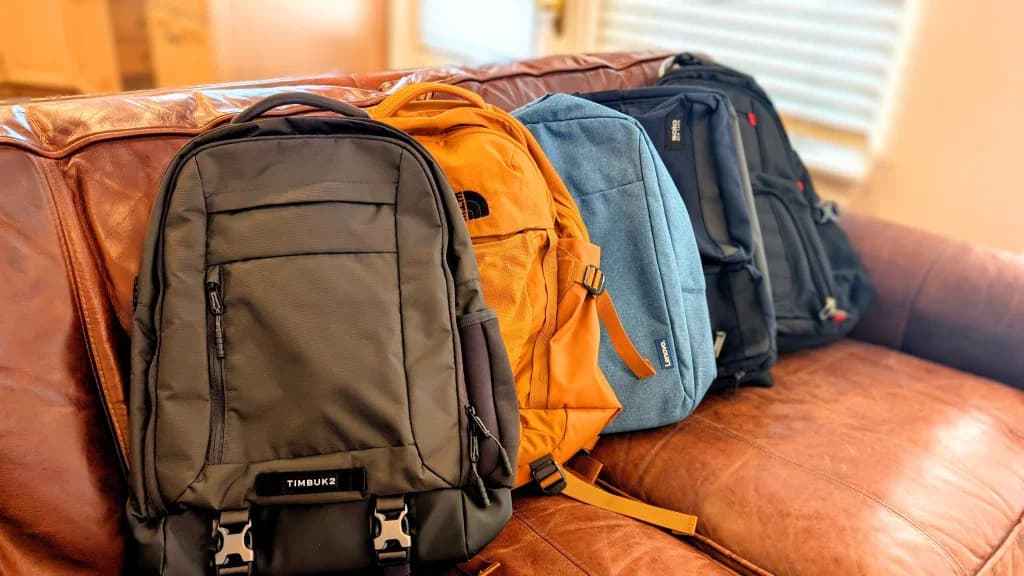
The bag on your shoulders right now is quietly solving about a dozen engineering problems at once. The straps keep the weight off your hands. The padded panel spreads pressure across your back. The zippers open and shut thousands of times and somehow keep working. The fabric is strong, light, mostly waterproof, and cheap enough that a student can afford it.
None of that is an accident. Somebody sat down with each of those problems, argued about it, tested a fix, and then tested it again.
The Weight Distribution Problem
Carry 10 pounds in one hand for a block and your arm is done. Carry the same 10 pounds on your back and you barely notice. That is not toughness, it is physics. A bag hanging off your hand creates a moment arm, which multiplies how hard your muscles have to work. A backpack parks that weight right up against your spine, and the math gets a lot friendlier.
Those shoulder straps are doing more than holding the bag on. A wider strap spreads the exact same weight across more surface, so the pressure on any one spot drops. Snowshoes work off the same idea. Padding helps too, because it squishes a little and evens out the load instead of digging into one line.
Weight Loading Order
How a Zipper Actually Works
Look closely at a zipper and you will see two rows of teeth facing each other. Every tooth has a little bump on one face and a matching hollow on the other. When you pull the slider, it lines each tooth up so the bump on one side drops into the hollow on the other. Click. Click. Click.
That is why a closed zipper feels so solid. Those interlocked teeth refuse to pull apart and refuse to slide sideways. Going the other direction, the slider wedges a tiny blade between the rows and pops the teeth apart one pair at a time.
- Metal zippers last longer but weigh more
- Plastic coil zippers are lighter and bend around curved seams
- YKK makes most of the world's zippers, and you will find that logo on almost any decent bag
- Zippers usually fail because the slider got stretched too wide, and a gentle squeeze with pliers can sometimes bring it back
Materials and Trade-offs
There is no perfect backpack fabric. Every option trades weight against durability against water resistance against price, and somebody had to pick.
- 1
Nylon
Strong, light, and it shrugs off scraping. Most expensive packs use it because it survives years without weighing much.
- 2
Polyester
A bit heavier than nylon, cheaper, and it does not fade as fast in the sun. This is what most school backpacks are made of.
- 3
Canvas
Tough and heavy, but it drinks water. Fine for a walk to class, rough choice for a rainy hike.
- 4
Ripstop
A weave with a grid of reinforcing threads baked in. Tear it and the grid stops the rip from spreading. You see this on high-performance packs.
Here is the part most people do not know: water resistance comes from a coating on the inside of the fabric, not from the fabric itself. That coating wears away over the years, which is why an old bag soaks through even though the outside still looks fine.
The Pocket System
Nobody scattered those pockets randomly. Each one is a bet somebody made about how you carry your stuff.
- The main compartment is sized around notebooks, a laptop sleeve, or a folded hoodie
- The front pocket holds what you grab constantly and do not want floating loose
- Side pockets are shaped for water bottles because that shape is everywhere and easy to predict
- The little top pocket is for what you need without unzipping the whole bag
- The internal organizer assumes you are carrying pens, keys, and a phone
Try This