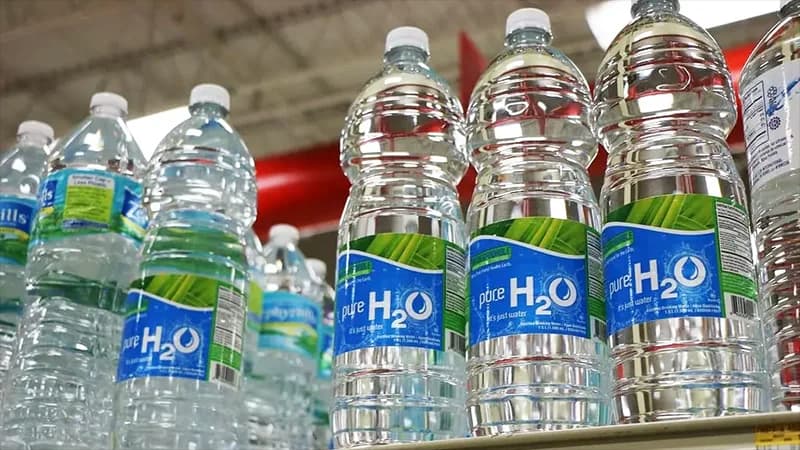
A single-use water bottle might be the least impressive object you will touch today. It holds water. You drink it. You throw it away. But look at it as a materials problem and it turns into something kind of ridiculous.
That bottle weighs a few grams. It survives a factory, a truck, a warehouse, a cooler, your backpack, and getting dropped on concrete. If it is holding soda, it also contains gas pushing outward on every wall. On top of all that it has to keep the water clean, seal without leaking, feel decent in your hand, and cost almost nothing to make a billion times over.
The Big Trade-off
The Engineering Feat
Almost all of them are made from PET, short for polyethylene terephthalate. PET is clear, light, easy to mold, and unusually strong for its weight. That combination is what lets a factory make walls thin enough to crinkle in your hand without the bottle falling apart on the shelf.
- 1
Lightweight and strong
A PET bottle holds thousands of times its own weight in water. Stretching the plastic during molding lines up the long polymer chains inside, and that alignment is a big part of where the strength comes from.
- 2
Thin but pressure-aware
Those ridges, curves, and the weird bumpy base are all structural. Soda bottles get the most careful geometry of all, because trapped gas is constantly pushing outward on every square inch.
- 3
Fast to manufacture
Machines heat a small PET preform that looks like a test tube, blow it into a mold, fill it, cap it, and label it faster than you can read this sentence. That speed is most of the reason bottled water is everywhere.
The Shape Is Not Random
A bottle has to be grabbable, stackable, and stiff enough not to fold when you pick it up. Those grooves around the middle are not styling. They give your fingers something to hold onto, which matters a lot when your hands are wet.
Shape also decides how the bottle handles pressure. A perfectly smooth thin-walled bottle crumples the second you squeeze it. Add ridges and the same amount of plastic gets noticeably stiffer. Less material, same job.
The Physics of the Cap
Look at the neck of the bottle. Those spiral ridges are threads, and the cap has matching threads cut inside it. When you twist, the threads drag the cap downward instead of just spinning it around.
That downward pull squeezes a small sealing ring against the rim. What you want is a hermetic seal, tight enough to stop leaks, hold in carbonation, and keep out air and bacteria.
And that little cap is a simple machine, the same family as a ramp or a screw. It converts an easy twist into a strong downward squeeze. Getting more force out than you put in is exactly what simple machines are for.
Why Is the Plastic Thicker in Some Places?
Run your fingers along a bottle from top to bottom and the thickness changes. The base has to be beefy enough to stand up and take a drop. The neck has to be solid enough for the cap to bite into. The sides can afford to be thin, so they are.
That is engineers balancing strength, cost, comfort, and waste at the same time. Too thin and it crushes in your hand. Too thick and you just wasted plastic on a billion bottles. Good design puts material exactly where the stress is and nowhere else.
The Opening Matters
Make the opening too small and drinking is annoying. Make it too big and you pour it down your shirt. Reusable bottles usually go wide so you can fit ice in and actually clean the inside. Disposables go narrow, because they only need to survive one use and nobody is scrubbing them out.
Even that hole size was somebody's decision.
Labels and Grip
The label wrapped around the middle is doing two jobs. Branding, obviously, but it also adds friction where your hand goes. Reusable bottles take this further with rubber sleeves, textured plastic, or powder-coated metal. A bottle that squirts out of a wet hand is a failed design, especially for kids or anyone halfway up a trail.
The Trade-offs and Health Concerns
Solving a problem beautifully does not mean you solved every problem. Single-use bottles come with a real environmental bill, and researchers are still working out what all those tiny plastic fragments mean for us.
- 1
Microplastic and nanoplastic particles
Newer microscopy can spot particles older methods missed completely. A Columbia and Rutgers team counted an average of roughly 240,000 detectable plastic fragments per liter in the bottled water they tested, and most of those were nanoplastics.
- 2
Cap friction
Every time you twist a cap on or off, plastic threads grind against plastic threads. Peer-reviewed research shows that grinding sheds additional microplastic particles right at the opening.
- 3
Chemical leaching
Heat, sunlight, months of storage, or reusing a bottle built for one trip all raise concerns about the plastic breaking down and additives moving into the water. Scientists are still sorting out exactly what that does to people.
- 4
Environmental impact
PET can be recycled. A lot of it is not. Bottles that end up as litter stick around in landfills, rivers, and oceans for a very long time.
Engineering Means Trade-offs
How to Reduce Plastic Exposure
Nobody needs to panic here, and a plastic bottle is still better than no clean water. But if you want to cut down on everyday plastic, the swaps are pretty easy.
- Carry a glass or stainless steel bottle for your daily water.
- Do not leave plastic bottles baking in a hot car or sitting in direct sun.
- Skip the habit of refilling a bottle that was built for one use.
- Add a certified filter at home if your tap water is safe but you want extra peace of mind.
- Recycle PET wherever your town takes it, and use refill stations when you can find them.
Try This: Bottle Design Test
Grab a disposable bottle and a reusable one and put them side by side. Compare the cap, the grip texture, the shape of the base, the wall thickness, the opening size, how easily each one squishes, how stable each one stands, and how you would go about cleaning either.
No Perfect Answer
Final Thought
A water bottle is a whole engineering project pretending to be a container. Hold liquid, do not leak, fit a hand, stand up, survive a drop, waste as little material as possible. It also happens to be a reminder that design decisions keep having consequences long after the product leaves your hands.
Next time you take a drink, spend two seconds looking at the bottle. There is more thinking packed into it than anybody meant you to notice.