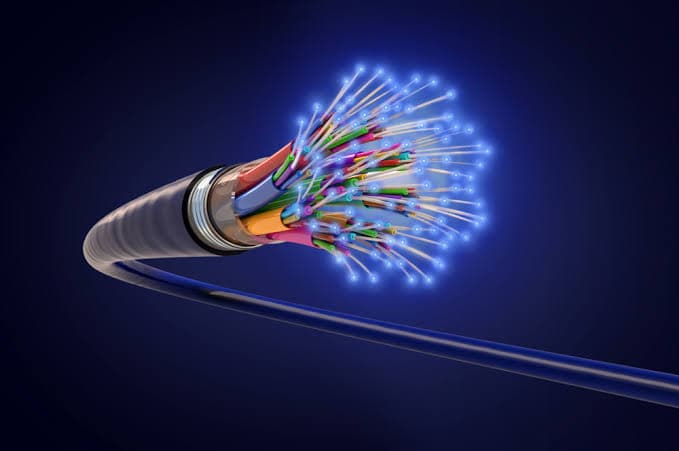
This page reached you as pulses of light. For most of its journey it was travelling inside a strand of glass thinner than a human hair, and a good part of that journey was along the floor of an ocean.
Which raises an awkward question, because light travels in straight lines and the cable does not.
Light Really Does Go Straight
It is not a simplification. Straight-line travel is why a pinhole camera works, why shadows have sharp edges, and why you cannot see around a corner.
So a fiber that curves under the sea should leak its light out at the first bend, like water out of a bent hose with a hole in it. It does not. A modern fiber can carry a signal something like fifty to a hundred kilometers before it needs any help at all.
The light is not bending. It is bouncing, and the bouncing is the part worth understanding.
The Bounce That Loses Nothing
When light inside a dense material like glass or water arrives at the boundary with something less dense, like air, one of two things happens. Hit that boundary steeply and most of the light escapes. Hit it at a shallow enough angle and none of it does. All of it reflects back inside.
There is a specific cutoff angle where the behavior switches over, called the critical angle. For water it sits at about 49 degrees. For glass it is closer to 42. Shallower than the cutoff and the light is trapped.
Why not just line the cable with mirrors?
How You Get Light to Stay Inside
Send light into a fiber at a shallow angle and it strikes the wall past the critical angle, reflects, crosses to the other wall, and strikes that one at the same shallow angle too. So it bounces again. And again, tens of thousands of times per kilometer, zigzagging its way along.
When the fiber curves gently, the geometry still holds. Each bounce keeps arriving shallower than the cutoff, so the light keeps being turned back inward and ends up following the curve. Bend a fiber too tightly and you break that condition, the angle goes past the cutoff, and the light escapes. Installers have a minimum bend radius for exactly this reason.
Real fibers do not rely on a glass-to-air boundary, because a scratch or a fingerprint would ruin it. Instead the glass core is wrapped in a second layer of glass called cladding, made slightly less dense on purpose. The bounce then happens at a boundary buried safely inside the cable.
Why Glass Beat Copper
- 1
Light can carry far more
Information is carried by flickering the signal on and off. Light waves cycle vastly faster than the electrical signals in a copper wire, so they can be flickered vastly faster too.
- 2
Many colors, one strand
A single fiber can carry dozens of different wavelengths at the same time, each one an independent channel, and they pass straight through each other without interfering.
- 3
It barely fades
Modern fiber is so transparent that if the ocean were made of it you could see the bottom. That is why the signal survives tens of kilometers between amplifiers.
- 4
It ignores electrical noise
A copper wire picks up interference from motors, lightning, and other cables. A photon is not bothered by any of it.
You Can Watch It Happen in Your Kitchen
You do not need glass. Water works, because water has a critical angle too.
Punch a hole low in a plastic bottle, fill it with water, and let the stream arc out into a sink. Shine a light in through the opposite side, straight at the hole, and the beam gets caught in the falling stream. It follows the arc all the way down and lights up the spot where the water lands.
Put a finger in the stream and the light stops dead at your finger, because you have broken the smooth surface it was bouncing off. That is the same failure mode as a fiber bent too tightly, and it is the clearest thirty seconds of the whole demonstration.
The Big Idea
Fiber optic cables do not bend light. They trap it, using a boundary that reflects perfectly whenever light arrives at a shallow enough angle, and then they let the trapped light follow wherever the glass goes.
See it for yourself
Our guide walks through the bottle, the hole, the stream, and the safety rules for the light source, plus how to measure how far the light stays trapped before it leaks out.
Bending light down a stream of water