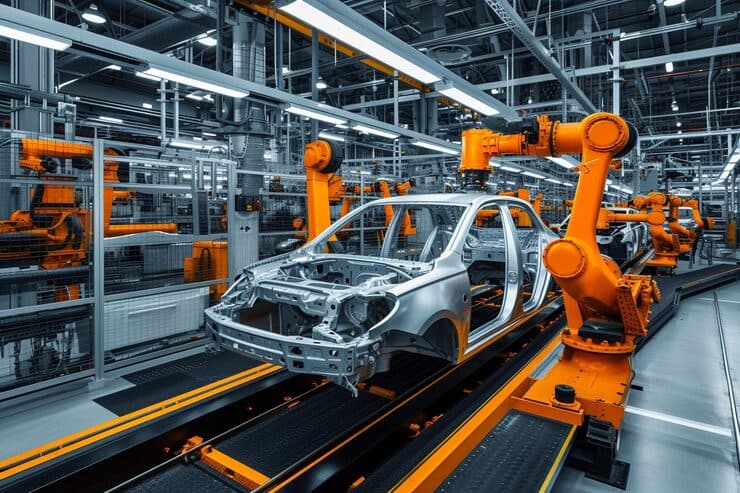
A car is thousands of parts pretending to be one object. Doors, seats, wheels, glass, miles of wiring, lights, a motor, and a huge number of pieces you will never see unless something goes wrong. Assembling all of that is an enormous job.
So modern factories hand the speed, strength, precision, and repetition to robots. Almost none of them look like people. Most look like giant mechanical arms bolted to the floor, swinging around with unsettling accuracy.
Factory Robots Are Great at Repetition
Doing the same thing perfectly, over and over, is the one job robots are genuinely better at than us. Car building is full of exactly that. The same part, placed the same way, welded in the same spot, thousands of times. A robot arm hits that mark every time. It does not get bored, does not zone out on a Friday, does not forget step four.
Welding the Car Body
Welding is the big one. It uses heat to fuse metal pieces into a single structure, and a car body has to be strong enough to protect people in a crash. Robot welding arms move fast, hit the exact same coordinates every time, and reach into corners a person would have to contort into.
None of that runs itself. Engineers, technicians, and workers design the systems, program them, watch them, repair them, and inspect the results. The robot does the repeated motion. Humans own the process.
Painting With Precision
Painting sounds easy right up until you try it. Too much and it runs. Too little and the coverage is thin and weak. The coat has to be even across a curved hood, a flat roof, and a door with a crease in it. Robots handle it because they can sweep a spray head in the same controlled pattern at the same distance every time, and your arm cannot.
Moving Heavy Parts
Car parts get heavy fast. Robots lift, carry, and position them without strain. One arm swings a door into place. Another system runs parts down the line. Hoisting something awkward and heavy four hundred times a shift wrecks human bodies, so this is a case where the robot is protecting people, not replacing them.
Safety and Programming
These machines are strong and quick, which makes safety a serious engineering problem on its own. Most industrial robots live inside fenced zones with sensors and warning lights, and the arm shuts down the instant a person crosses the line. Newer machines called cobots, short for collaborative robots, are built with extra safety systems so they can work right next to people.
And no robot arrives knowing how to build a car. Somebody programs every move: where to go, how fast, when to fire the tool, how much force to apply, and what to do the moment something goes wrong. A factory floor is robots, conveyors, cameras, tools, and people all choreographed into one very long process.
The Big Idea
Factory robots weld, paint, haul parts, and repeat precise motions until the shift ends. They are not human-shaped because they were never meant to be. A welding robot and a painting robot look completely different, because they are solving completely different problems.