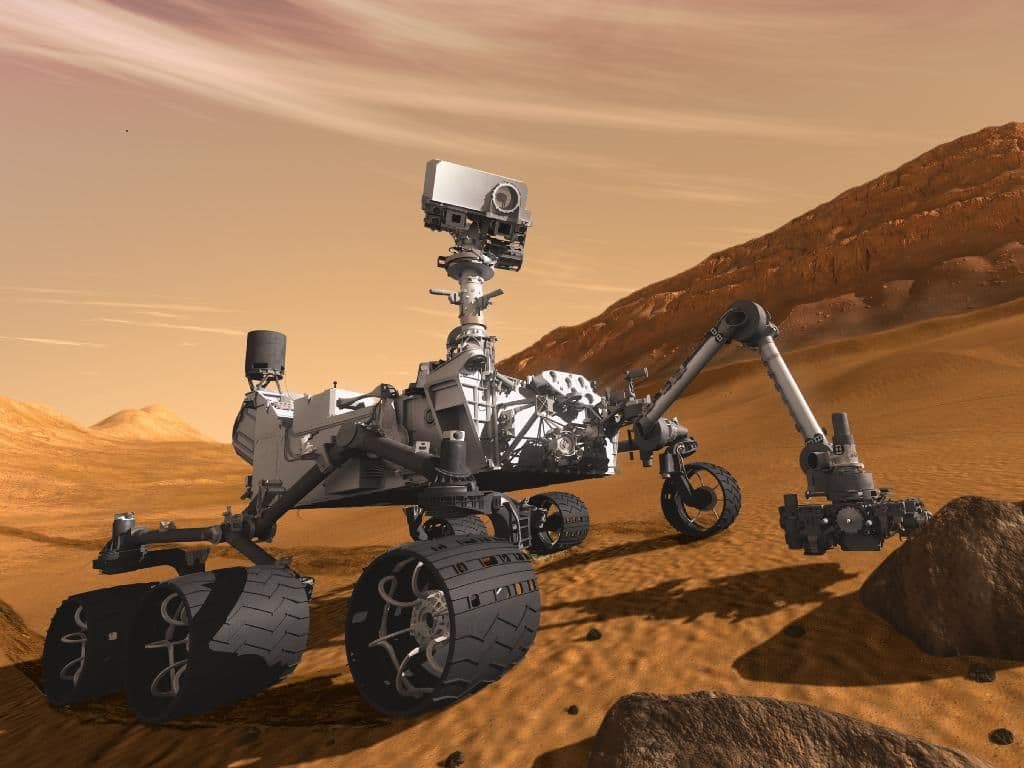
Right now, as you read this, there are robots driving around on Mars. They cross the surface of another planet, study rocks, take pictures, and send it all home. Nobody is behind the wheel. There is no astronaut nearby with a controller. There is nobody on that planet at all.
So how does a rover drive itself? It comes down to distance, cameras, wheels, careful planning, and an almost unreasonable amount of patience.
Mars Is Very Far Away
Mars sits millions of miles out, and radio signals, fast as they are, still take real time to cross that gap. Depending on where both planets are in their orbits, a message can take several minutes each way.
So nobody is driving this thing like a video game. Imagine the rover rolling toward a rock it should not hit. An engineer on Earth will not even see the problem for ten minutes, and the stop command takes another ten to get back. By then the rover has been stuck for twenty minutes.
The Rover Gets Instructions
A rover does not wake up and pick a direction. Back on Earth, teams pore over the images and data it sent overnight, study the landscape, and choose targets worth visiting. An interesting rock. A patch of soil. A ridge. A route that will not eat a wheel.
Then they beam up a plan: drive to this spot, photograph that, drill here, run this instrument. But because of the delay, the plan cannot cover everything. The rover has to be able to handle surprises alone.
Cameras Are the Rover's Eyes
Rovers are covered in cameras, and each set has a job. Some look ahead to plan the next few meters. Some watch the ground directly under the wheels. Some grab wide landscape shots. Others zoom in close so scientists can study a rock without ever touching it.
Those images are also how it spots trouble: a boulder, a steep slope, a hole, sand it might sink into. Mars is not a parking lot. It is dust, stones, ridges, and craters, and a stuck rover stays stuck forever.
Wheels Built for Another Planet
Rover wheels are built for terrain nobody has ever tested in person. They have to climb rocks, shed dust, carry the whole rover, and survive brutal cold with no maintenance, ever.
Flat tire on your bike? Somebody patches it. Cracked wheel on Mars? Engineers on another planet redesign how the rover drives to work around the damage. That is exactly why rovers move so slowly and so carefully. Nobody is trying to set a speed record. They are trying to keep exploring.
The Rover Can Avoid Some Trouble
Rovers run autonomous navigation, which means they handle some of the driving themselves. Earth says go toward that point. Along the way, the rover checks its own camera feed. If it spots a nasty rock or a slope it does not like, it can steer around it or just stop and wait.
The Big Idea
A Mars rover drives without a driver by combining instructions from Earth, cameras that read the terrain, wheels built for a hostile planet, and software that knows when to stop. It cannot be steered live, because the universe is too big for that.
Every slow turn of those wheels is part of something larger: exploring a place no human has ever stood.