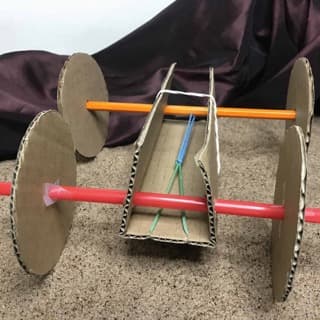
NASA's Mars rovers work 140 million miles from the nearest repair shop. A wheel cracks, a sensor dies, and there is nobody out there to fix it. Ever. Every single design choice gets made with that in mind.
You are not building for 140 million miles today. But you are stuck with the same kinds of limits: whatever materials you can find, a weight you cannot exceed, ugly terrain, and a rover that has to actually work when someone tests it in front of you.
The Mission Brief
Your Mission
What You Need
- Cardboard (cereal boxes, delivery boxes, any flat cardboard)
- Duct tape or masking tape
- Scissors
- Cardboard tubes (paper towel or toilet paper rolls)
- Straws
- Small paper cups
- Optional: brass fasteners, rubber bands, a ruler
Your Design Goals
Real engineers get graded against specific requirements, not vibes. Here are yours:
- 1
Carry a payload
Balance a small cup holding 3 quarters or 3 rocks on top. If it tips, you failed the mission.
- 2
Clear terrain
Roll over a crumpled piece of notebook paper without getting stuck or stalling out.
- 3
Survive a drop
Drop it from knee height. It has to stay in one piece and still roll afterward.
- 4
Bonus: the arm
Add something that reaches out from the body, like a rover arm, and can dip toward the ground while the rover itself stays put.
Your Design Constraints
Every real engineering job comes with rules you did not pick. Working inside them is the whole job. Here are yours:
- It has to fit inside a shoebox
- No hot glue. Tape and fasteners only
- Wheels have to be round. Actually round, not sort of round
- 45 minutes on the clock
- Before you test, you have to explain one choice you made and why
Engineering Questions to Think Through Before You Build
- 1
How many wheels?
Four beats three for stability, but every wheel you add is more weight and one more thing that can snap. Real rovers run six, each one mounted so it moves on its own. That way a single rock does not flip the whole vehicle.
- 2
Where is the weight?
Weight up high tips easy. Weight down low stays put. Get your heavy parts as close to the ground as you can.
- 3
How wide is the wheelbase?
The gap between your left and right wheels is called track width. Wider is harder to tip sideways. Narrower squeezes through tight spots. Pick your problem.
- 4
What happens when one wheel hits a bump?
With a rigid axle, one bump lifts that entire side of the rover. Real rovers use rocker-bogie suspension so each wheel can move on its own. Now the fun question: can you fake that with cardboard and tape?
Test It, Then Ask These Questions
- Did it tip during the payload test? Where was all the weight sitting?
- Did the crumpled paper stop it? Did a wheel sink in, or did the body drag?
- Did it survive the drop, and if not, what gave out first?
- If someone handed you ten more minutes, what is the one thing you would change?
Write the answers down or sketch them. That page is the difference between a first build and a genuinely better second one.
“One student added a ramp on the front of his rover using a bent strip of cardboard. He said it was for pushing rocks out of the way. I asked if he had seen that on a real rover. He said no, he just thought it would help. That is the right kind of thinking.”
The Real Rover Connection
Perseverance, the rover currently rolling around Mars, weighs about 1,025 kilograms and rides on six wheels that each move independently. It hauls cameras, a microphone, a drill, and a whole helicopter named Ingenuity. Every piece had to be light enough to launch, tough enough to survive landing, and reliable enough to keep working for years with nobody around to help.
Weight distribution, wheel count, ground clearance, payload. Those are the exact questions rover engineers argue about at NASA. You are answering the same ones. The only difference is the budget.
Try Engineering in Person
At our workshops, students take on design challenges like this one and find out fast whether their build holds up.
See upcoming workshops