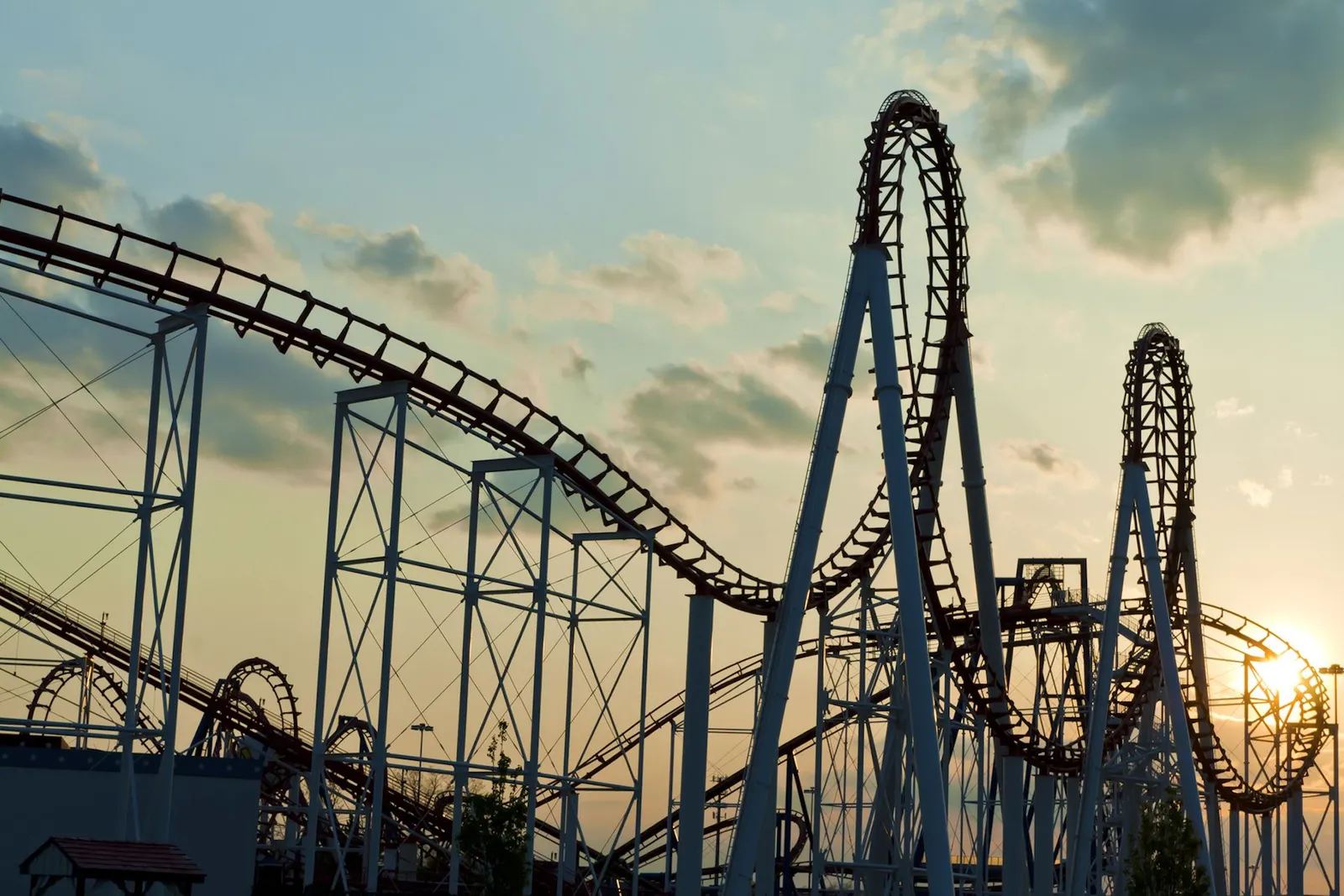
Roller coasters look like they are cheating. They haul up an impossible hill, plunge down, snap sideways, and flip you upside down while your stomach files a complaint. So why does the train never leave the rails? Gravity, momentum, some very clever wheels, and a lot of engineers who really did not want you to fall out.
Gravity Starts the Ride
That slow clanking climb at the beginning is the whole ride getting loaded up. A chain or a launch motor drags the train to the top, and once it is up there, it is holding a bank account of energy just from being high off the ground. Engineers call that potential energy.
Then the track drops out from under you and gravity spends every bit of it. Stored energy becomes speed, which is kinetic energy. That first drop is not just for screaming. It is paying for the entire rest of the ride.
Momentum Keeps It Moving
Now the train is moving, and moving things want to keep moving. That is momentum, and it is what carries you over the next hills, around the curves, and up through the loops.
But friction and air resistance are stealing from you the entire time. So designers have to nail a narrow window: enough speed to make it home, not so much that the ride turns dangerous. Too slow and the train stalls upside down. Too fast and the forces get ugly.
The Wheels Do More Than You Think
The train is not just sitting on the rails like a car on a road. Look under one sometime and you will find three sets of wheels doing three different jobs:
- Road wheels riding on top of the rail
- Side friction wheels pressing against the outside, holding the train in line through turns
- Up-stop wheels underneath the rail, gripping from below so the train stays locked on when you go upside down
So during a loop, the coaster is not politely hoping gravity cooperates. It is physically clamped around the rail from three directions.
Why Do You Not Fall Out?
Lap bars, seat belts, over-the-shoulder harnesses. Which one you get depends on what the ride is about to do to you. A gentle family coaster only needs a lap bar. Anything that flips you gets a much more serious restraint.
The design goal is a little sneaky. Engineers want you to feel like you are barely hanging on while you are, in fact, extremely attached to the seat. A good coaster feels reckless and is anything but.
Loops Are Not Perfect Circles
Here is a detail most riders never notice. Coaster loops are not circles. They are shaped like a stretched teardrop, wide at the bottom and pinched at the top. A true circle would crush you with force at the bottom and then leave you too slow at the peak.
The teardrop spreads those forces out so your body can handle them. It looks like a design choice. It is actually a rescue plan for your neck.
Try This: Marble Coaster
Paper, cardboard, tape, and one marble. Build a track with a hill and a curve. Then start sabotaging it. Make the first hill too short. Make the curve too tight. Leave the track bumpy. Every single failure tells you exactly what to fix.
Same Questions, Smaller Scale
Final Thought
The train stays on the track because every piece was designed to keep it there. Gravity supplies the speed, momentum carries it home, wheels grip from three sides, restraints hold you down, and the shape of the track controls what your body feels. The thrill is completely real. So is the math underneath it.