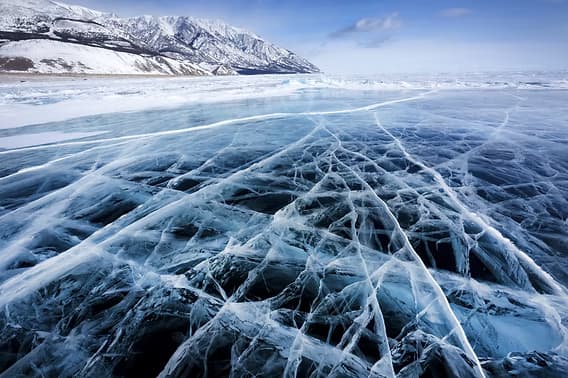
Sidewalk: no problem. Ice: total betrayal. One second you are walking normally, the next your foot has left without you, your arms are doing something desperate, and you are negotiating with physics.
So what makes ice so much worse than everything else? It comes down to friction, the surface itself, the temperature, and what is happening in the paper-thin gap between your shoe and the ground.
Friction Helps You Walk
Friction is the force that fights sliding, and walking runs entirely on it. Every step, you shove backward against the ground and friction shoves you forward. No friction, no push, no walking. Your foot just goes.
Dry pavement is rough at a scale you cannot see, and all that roughness gives your sole something to bite into. Ice is smooth at that same scale, so there is nothing to bite.
Ice Has a Slippery Surface
Ice looks like a solid block, but the very top of it behaves strangely. Under a lot of conditions there is an incredibly thin film of water sitting on the surface, and that film is what turns bad into catastrophic.
So your shoe is not gripping solid ground. It is gliding across smooth ice on a microscopic layer of water doing the exact job oil does inside an engine. You are being lubricated on purpose by nature.
Temperature Matters
Not all ice is out to get you equally. Ice hovering near its melting point is the worst, because that watery surface layer forms easily. Really cold ice, the kind that squeaks underfoot, can actually be less slick, because there is less liquid up top.
Do not read that as safe. Cold ice will still take you out. Temperature just changes how it does it.
Shoes Matter Too
Your shoes are half the equation. A flat, worn sole has nothing to work with. Deep tread digs into snow and uneven surfaces and buys you grip, which is exactly why winter boots have aggressive patterns molded into the bottom. But be honest with yourself: on truly smooth ice, even great boots can lose. There is simply nothing there to grab.
Why Do We Slide So Fast?
Low friction means almost nothing is stopping your foot once it starts moving. On pavement, a small slip gets killed by friction in an inch or two. On ice, the slip just keeps going, and a tiny loss of balance turns into an entire unplanned journey.
Ice Is a Design Challenge
Whole professions exist to fight this. Road crews, city planners, tire engineers, boot designers, people who build sports surfaces. Salt melts the ice away. Sand throws roughness back on top of it. Tire treads carve channels to shove water and slush out of the contact patch. Different tools, one goal: get some grip back.
The Big Idea
You slip on ice because ice barely has friction. Its smooth surface, that thin water film, the temperature, and whatever is on your feet all decide how much grip you get.