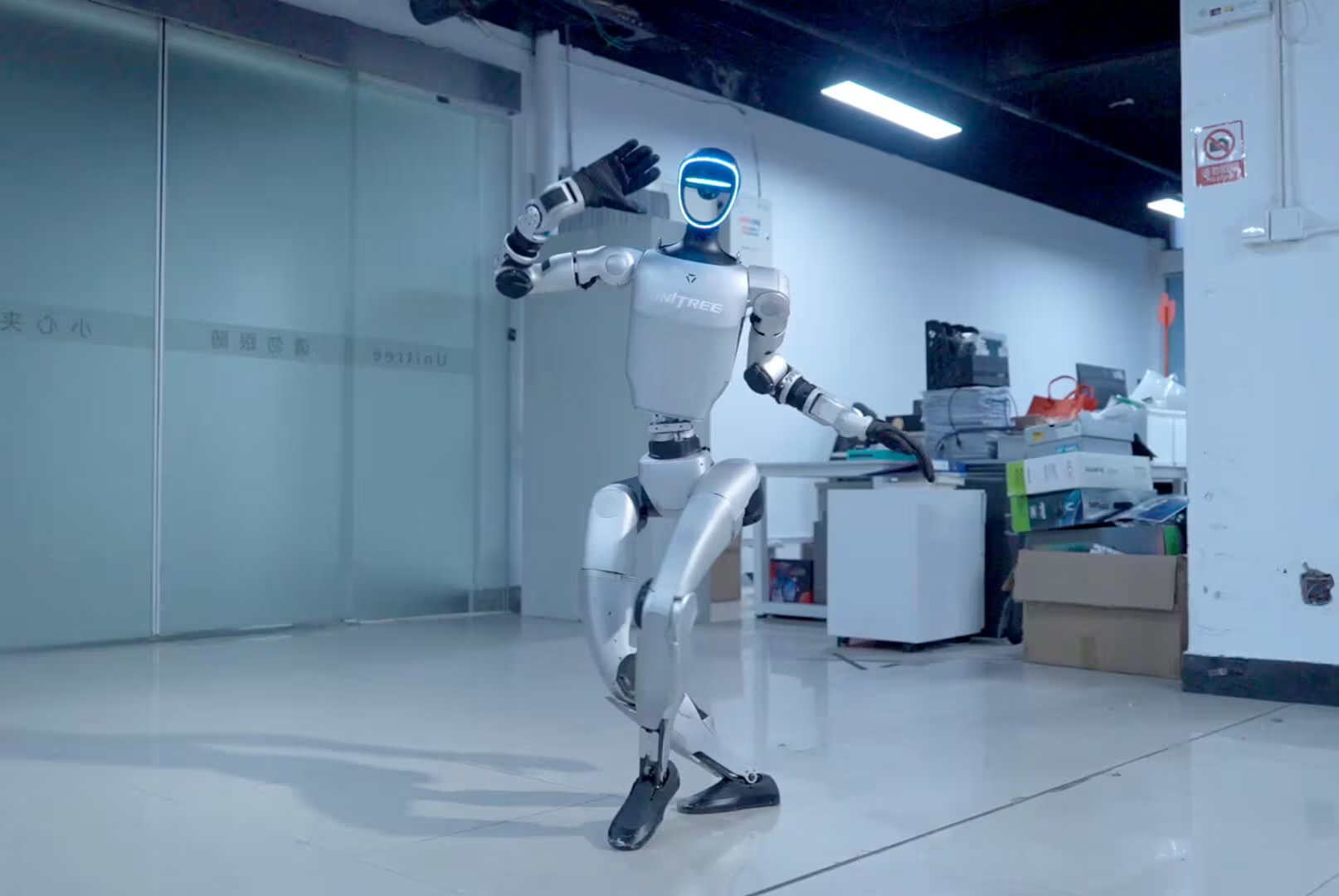
Folding laundry is nothing. You grab a shirt, shake it out, find the sleeves, fold, done. You are probably thinking about something else the entire time.
For a robot, folding laundry is close to a nightmare. Same goes for opening a door, picking a toy off the floor, tying a shoe, or pouring cereal without launching it across the counter. These are some of the hardest unsolved problems in robotics.
Which is strange, because robots build cars, drive on Mars, and throw around parts that would flatten a person. So how does a sock beat them? Because the real world does not hold still and does not hold its shape.
Humans Are Better Than We Realize
Your body pulls off ridiculous stuff constantly and never mentions it. Reach for a pencil and you instantly know where it is, roughly what it weighs, how tight to squeeze, and how to angle your fingers, even if it is sideways, half under a notebook, and hanging off the edge of the desk.
A robot has to grind through every one of those steps. See the pencil. Work out that the pencil is a separate object from the table it is lying on. Choose a grab point. Plan an arm path that does not knock over the water bottle. Squeeze hard enough to lift it and not hard enough to snap it. That is five hard problems for one pencil.
Soft Things Are Hard
Anything floppy is a robot's worst day. A shirt refuses to be one shape. It bends, bunches, twists, and collapses into a pile that looks nothing like a shirt. A towel folds over itself. A sock hides inside another sock like it is doing it on purpose.
Rigid objects are so much friendlier. A metal block stays a block. A plastic bin has edges you can find. A cup looks like a cup. Cloth changes shape every single time it moves, so a robot cannot just memorize what a shirt looks like. It has to understand how fabric behaves, and that is a genuinely brutal problem.
Opening Doors Is Not That Simple
Count the doors you have opened this week. Round knobs, lever handles, sliders, push bars, pull handles, heavy fire doors, screen doors that snap shut behind you. All different.
You walk up and just know what to do. A robot has to spot the handle, work out which way it moves, line up its gripper, apply the right amount of force, and step backward or forward while pulling or pushing. Push when it should pull and it fails. Grip at a slightly wrong angle and it fails. Two seconds of your life is a research project for somebody.
The World Does Not Stay Still
Factory robots are incredible at repetition because their world never changes. The part shows up in the same spot at the same second every time. The arm runs the same motion. Nothing surprises anybody.
Your house is the opposite of a factory. The backpack is on the floor today and on the chair tomorrow. The toy is upside down. The dog moved. If your pencil rolls under a chair, you crouch, shove the chair, reach around a bag, and grab it without a single conscious decision. That kind of improvising is still one of the biggest walls in robotics.
Picking Things Up Takes Judgment
You adjust your grip automatically and you have never once thought about it. An egg gets a completely different hand than a hammer. A paper cup gets different fingers than a baseball. Different pressure, different contact points, different everything.
A robot has to get that right on purpose. Too soft and the object drops. Too hard and it cracks. Grab the wrong end and it twists out of the gripper. And it gets worse when the object is shiny, see-through, squishy, tiny, heavy, weirdly shaped, or already moving. That is why grippers are one of the biggest fields in the whole industry.
The Big Idea
Robots are extraordinary. The world they have to operate in is just extraordinarily messy. What feels easy to you feels easy because you are absurdly good at sensing, balancing, touching, adjusting, and learning from every mistake you have ever made.