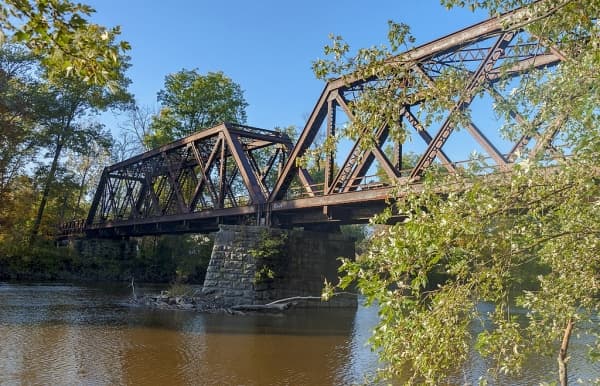
Every engineering workshop we run, a student looks at the bridge that just held the most weight and asks the same thing: why does that one work? The answer keeps coming back to a single shape. The triangle.
This is not a rule to memorize and forget. Once you get why triangles are special, you cannot unsee them. Bridges, towers, bike frames, roofs, roller coasters. They are hiding in all of it.
The Problem With Squares
Picture a square you taped together from four sticks. Push one corner and the whole thing leans over into a diamond. Engineers call that deformation, and it happens because all four joints can swivel.
The Key Difference
So the square is the wrong shape to hold weight, and the triangle is the right one. That is the whole story in two sentences.
What Happens When You Add One Diagonal
Now try this. Take that same floppy square and lay one stick diagonally across the middle. You just made two triangles, and the frame goes from wobbly to solid.
The extra stick is not just reinforcement. It splits the square into two shapes that cannot deform, and suddenly the whole panel is rigid. Students at our bridge workshops feel this the second they add a diagonal. The panel that used to fold over now fights back.
Why Triangles Show Up Everywhere in Engineering
Once you know what to look for, you will start catching triangles doing structural work all over the place.
- Truss bridges: a whole chain of connected triangles carrying the load from one end to the other
- The Eiffel Tower: a lattice of triangles that lets it sway in wind instead of snapping
- Bicycle frames: look at the main frame and you are looking at a triangle
- Rooftop rafters: the A-shape of a pitched roof is a triangle holding up the whole thing
- Construction cranes: that long boom is a triangular lattice lifting absurd amounts of weight
- Roller coasters: triangulated supports handle riders slamming through direction changes
The Science Behind It: How Forces Move Through Triangles
- 1
Triangles turn forces into pulls and squeezes
Push down on a triangle and every member either gets stretched (tension) or squeezed (compression). Nothing bends. Bending is what breaks things.
- 2
All three sides share the work
A square dumps all its stress into the corners. A triangle spreads the force along every side at once.
- 3
The shape refuses to move
As long as no member fails, a loaded triangle stays exactly the shape you built it. A square cannot promise you that.
Try It Yourself
No lab required. Grab four popsicle sticks and some tape and see it happen in about two minutes.
- Tape four sticks end to end into a square. Push one corner and watch it lean.
- Lay a fifth stick diagonally across the middle. Push the same corner. It barely budges.
- Now build a plain three-stick triangle and see how much more solid it feels.
- Chain a few triangles together in a row and find out what you can hold up.
What This Means for Your Bridge
Ready to build one and want the step-by-step? Our popsicle stick bridge project guide walks through a full truss bridge using everything above.
Build a Truss Bridge
At our engineering workshops, students build popsicle stick bridges and then pile on weight until something finally gives.
See upcoming workshops