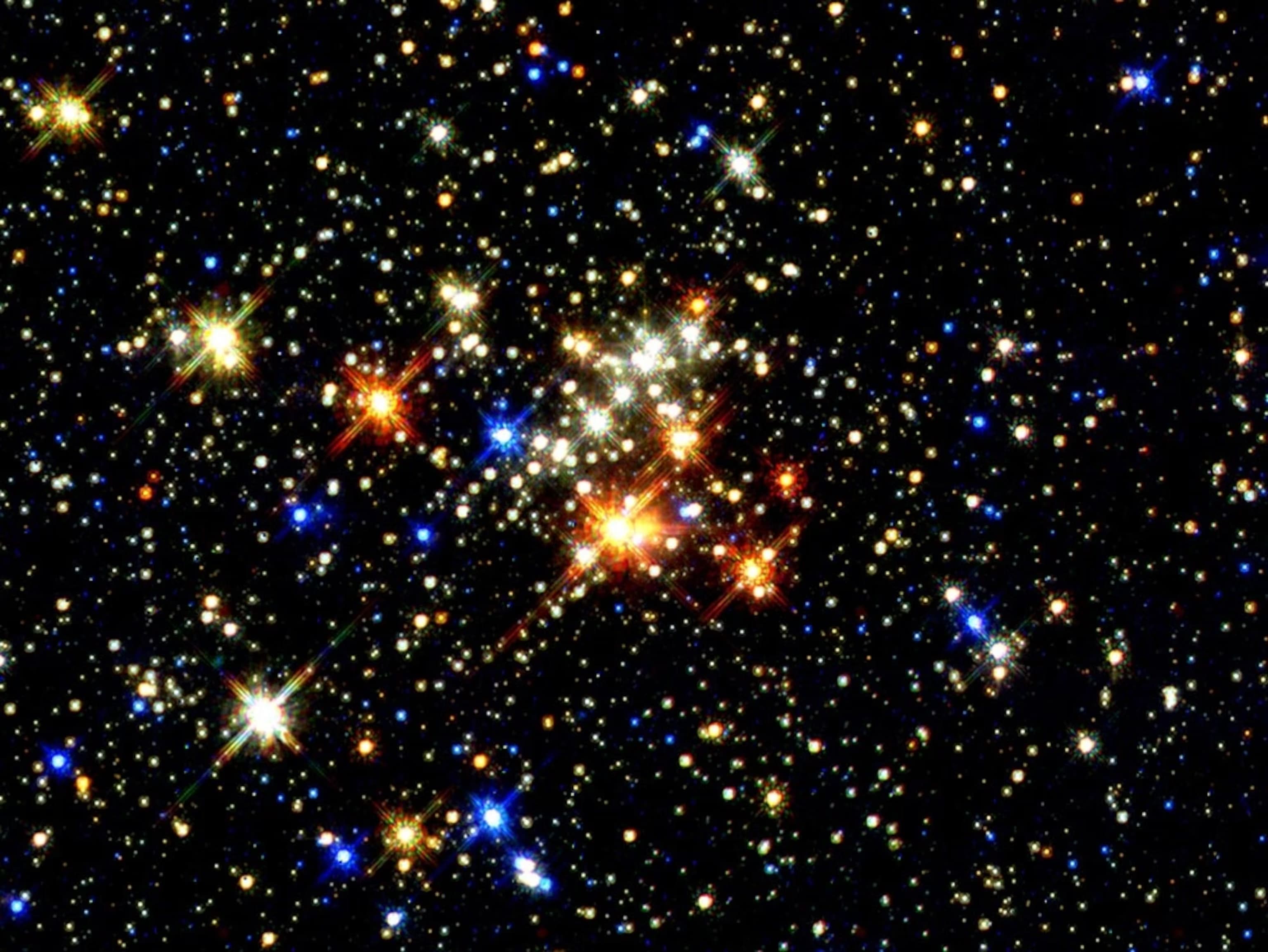
Nobody has been to a star. Nobody has brought a piece of one back. The closest one is 150 million kilometers away and everything after that is unreachable for a very long time.
And yet we can tell you what stars are made of, in what proportions, how hot they are, and whether they are moving toward us or away. All of it came from light, and you can do a simplified version of the same measurement with a cereal box.
Split the Light and It Stops Being One Color
White light is not a color. It is every color at once, and the only reason it looks white is that your eye adds them all together.
Spread them back apart, with a prism or with something that has microscopically fine grooves in it, and the mixture separates. What you get is called a spectrum, and it is the single most useful thing in astronomy.
Some Lights Give You a Rainbow, Others Give You Stripes
Take the spectrum of an old filament light bulb and you get a smooth continuous band. Red bleeds into orange bleeds into yellow, with nothing missing anywhere.
Now take the spectrum of a fluorescent tube. It looks nothing like that. Instead of a smooth band you get a handful of separate bright lines with darkness between them: a strong green, a pair of yellows, a blue. Only certain exact colors are there, and the rest were never emitted at all.
The difference is what the light is coming from. A hot solid glows in every color because its atoms are crowded together and constantly jostling each other. A thin glowing gas has atoms far enough apart to act on their own, and on their own they are astonishingly picky.
Why an Atom Is Picky
Here is the part that took physics a long time to accept. An electron inside an atom cannot have just any amount of energy. It can only occupy certain fixed levels, and there is no in between.
Think of a ladder where you can stand on the rungs but there is genuinely no space between them. Not a ramp with steps drawn on it. A ramp does not exist for an electron.
When an electron drops from a higher rung to a lower one, the leftover energy leaves as a single photon, and the energy of that photon is set exactly by the size of the gap it fell across. Photon energy determines color. So a fixed set of gaps produces a fixed set of colors, and nothing else.
This is where quantum mechanics came from
Every Element Has Its Own Set of Stripes
Different elements have different rungs, so they emit different colors. Sodium produces an intense pair of yellow lines so close together they look like one, which is why old street lamps had that unmistakable orange glow. Hydrogen has a red line, a blue-green one, and a couple in violet. Neon has a crowd of reds and oranges, which is why a neon sign is that color and not some other.
Those patterns do not shift. They are the same in a laboratory in New Jersey and in a star. So if you spread out the light from something unreachable and find sodium's yellow pair sitting exactly where sodium's yellow pair belongs, you have identified sodium in an object you will never touch.
Helium Was Found in the Sun Before It Was Found on Earth
During a solar eclipse in 1868, astronomers examined the spectrum of the glowing edge of the sun and found a yellow line that did not match any known element. It was not sodium, it was not anything on the list.
The conclusion was bold and correct: the sun contains an element nobody on Earth had ever isolated. It was named helium, after helios, the Greek word for sun.
It took another twenty-seven years before anyone found helium on Earth to confirm it. An element was discovered by looking at a stripe of light, ninety-three million miles from the nearest sample.
Dark Lines Tell You What Got in the Way
There is a second trick hiding in the same spectrum. Atoms absorb precisely the colors they would emit, so cool gas sitting in front of a hot source removes those exact colors from the light passing through.
Spread out sunlight carefully and the rainbow is crossed by hundreds of thin dark gaps. Each one is a color that got absorbed on the way out, by a specific element in the sun's own atmosphere. The missing colors are the message.
You Can Do the Simple Version With a Cereal Box
A CD has grooves packed closer together than the wavelength of light, which makes it a diffraction grating: the working part of a real spectroscope. Tape one inside a cereal box with a narrow slit at the far end and you have an instrument.
Point it at daylight bounced off a wall and you get the smooth continuous band. Point it at a fluorescent tube and the separated lines appear. Nobody has to tell you they are there. You just look, and there they are.
Build the spectroscope
Our guide covers the slit, cutting the disc safely, getting the angle right, and a comparison sheet for sketching four different light sources side by side.
Build a spectroscope from a CDThe Big Idea
We know what stars are made of because atoms can only emit and absorb specific colors, those colors are a fingerprint, and light carries the fingerprint across any distance without changing it.
Experimente Isto a Seguir
Continue Explorando
Por Que o Céu É Azul mas o Pôr do Sol É Alaranjado?