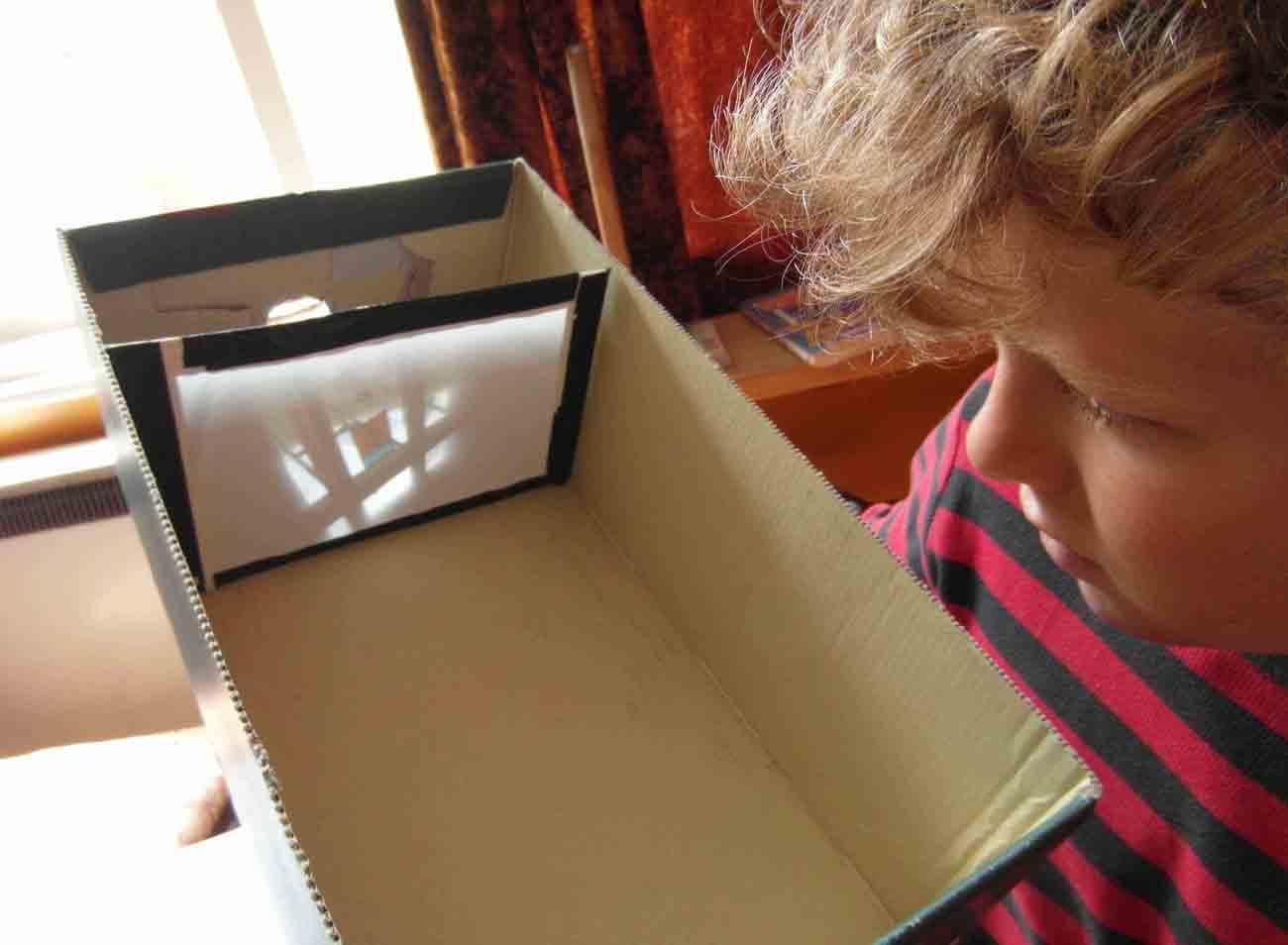
No lens. No battery. No film, no sensor, no app. A cardboard box with one pinhole in it will show you a full-color, moving picture of the world outside, and it has been doing that for at least a thousand years.
It is also the simplest way to understand what every camera, and your own eye, is actually doing.
Light Goes Straight, and That Is the Whole Trick
Every lit-up point in front of you is throwing light in every direction at once. The top of a tree outside your window is sending rays toward the sky, toward the ground, toward your face, and toward every part of the wall behind you.
Now put a wall between the tree and a sheet of paper, and punch one small hole in it. Almost all of those rays get stopped. From the top of the tree, only the one narrow bundle aimed exactly at your hole makes it through, and because light travels in straight lines, that bundle keeps going and lands on one small spot on the paper.
The same thing happens for every other point on the tree. Each one gets its own small spot. Line up all those spots and you have a picture.
Why the Picture Is Upside Down
Rays from the top of the tree are travelling downward as they pass through the hole, so they land low on the paper. Rays from the bottom are travelling upward, so they land high. The two paths cross each other right at the pinhole.
Nothing is flipping the image. It arrives inverted because straight lines through a single point have no other option, and left and right get swapped for exactly the same reason.
Try this
Smaller Hole, Sharper Picture
A hole is not really a point, it is an opening with a width. So each point on the tree does not make a perfect dot on the paper, it makes a small disc, roughly as wide as the hole itself.
Make the hole bigger and every one of those discs gets wider. They start overlapping their neighbors, and overlapping discs are what blur looks like. Make the hole smaller and the discs shrink, the overlap shrinks, and detail appears.
You pay for it in brightness. A smaller hole lets less light through, so the picture that gets sharper also gets dimmer. That trade is not a flaw in cardboard cameras. Photographers still make exactly this trade every time they change the aperture on a modern lens.
So Why Not Make the Hole Microscopically Small?
Because light stops cooperating. Below roughly half a millimeter, a strange thing happens: instead of continuing in a tidy straight line, light passing through a very narrow opening spreads out as it leaves.
That spreading is called diffraction, and it means the discs start growing again. There is a sweet spot, a hole size where the shrinking from geometry and the spreading from diffraction balance out, and your picture is as sharp as that box will ever get. Go smaller than that and you make things worse.
The same effect, doing something useful
Your Eye Is Doing This Right Now
Your eye is a dark box with a hole in the front. The hole is your pupil, and the back wall is your retina. The image landing on your retina at this moment is upside down and backwards, exactly like the one in a shoebox.
Your eye then adds something a pinhole camera does not have: a lens, which lets the opening be much wider while still bringing rays back to a sharp point. That is how you get a picture that is bright and sharp at the same time, instead of having to pick one.
Your brain handles the upside down part without ever mentioning it to you.
The Big Idea
A camera does not need glass, electronics, or anything clever. It needs a dark space, one small opening, and the fact that light travels in straight lines. Everything after that, lenses included, is an improvement on a picture that already exists.
Build one
Our step-by-step guide walks through sealing the box, making a clean pinhole in foil, and swapping in three different hole sizes so you can find the sharpest one yourself.
Shoebox camera obscura guideExperimente Isto a Seguir
Continue Explorando
Por Que o Céu É Azul mas o Pôr do Sol É Alaranjado?