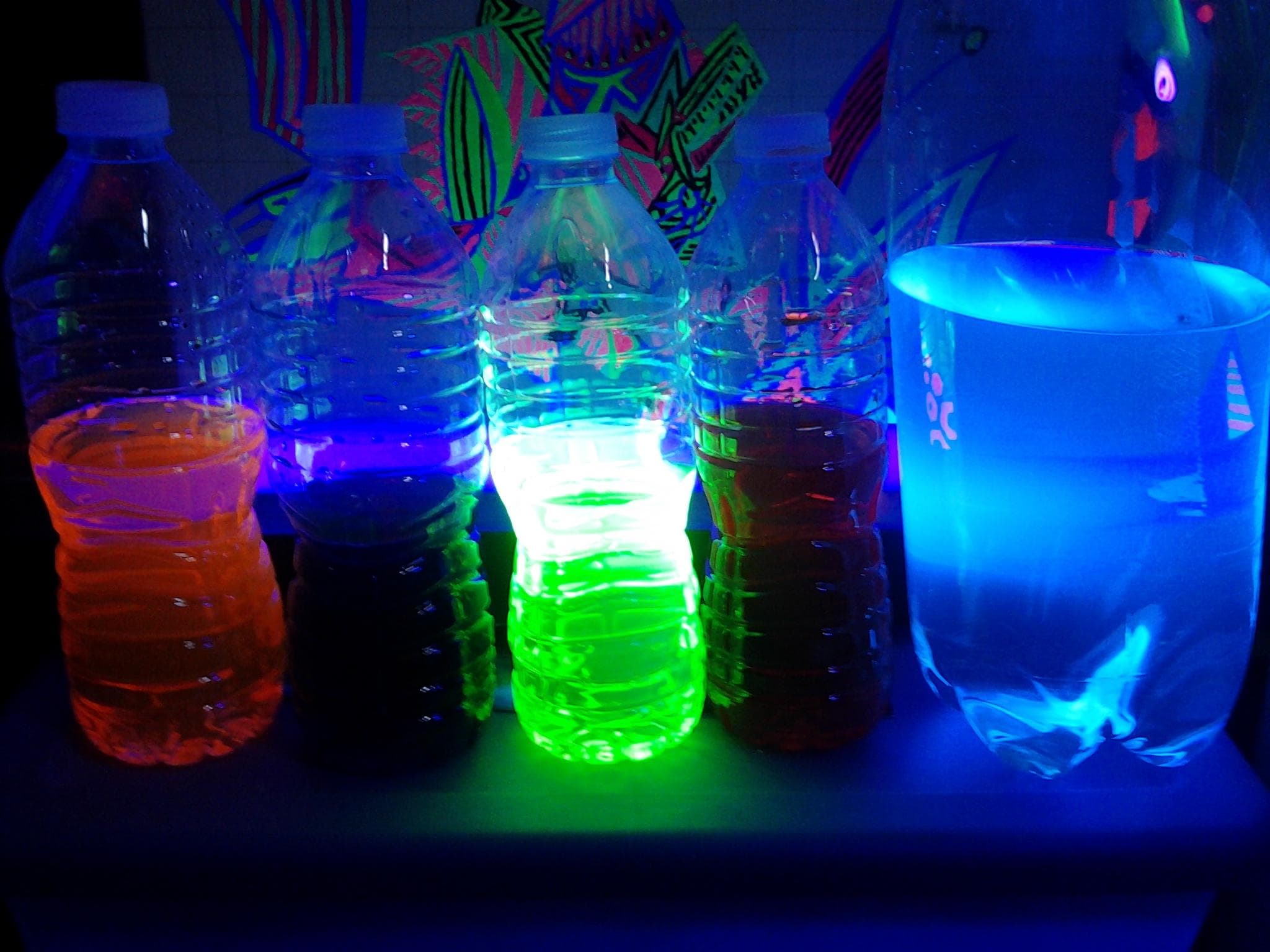
Switch on a blacklight and ordinary things start behaving strangely. Tonic water turns a vivid blue. A highlighter mark blazes. White socks light up, laundry powder glows, and a banknote reveals a strip that was invisible a second ago.
The strangest part is that the lamp does not look like it is putting out much of anything. So where is all that color coming from?
Ultraviolet Is Light You Cannot See
Your eye handles a band of colors from red at one end to violet at the other. Just past violet, the waves keep getting shorter and your eye simply stops reporting them. That is ultraviolet.
Shorter waves mean more energy per photon. An ultraviolet photon arrives carrying more punch than any photon you can actually see, and that extra energy is the whole reason the glow happens.
A cheap blacklight is not pure ultraviolet, which is why it looks faintly purple: a little visible violet leaks out along with the invisible part.
The Glow Is New Light, Not Reflected Light
This is the piece people usually get wrong. A glowing highlighter mark is not bouncing the lamp's light back at you. It is absorbing that light, keeping it for a fraction of a billionth of a second, and then making its own.
You can tell because the color changes. Reflection cannot do that. A red shirt under blue light looks dark, not red, because reflection can only give back a subset of what fell on it. Something invisible going in and bright blue coming out is not reflection at all.
Up, Then Down, With a Little Lost on the Way
- 1
Absorb
An ultraviolet photon hits the right kind of molecule and is swallowed whole. Its energy lifts an electron up to a higher energy level.
- 2
Settle
The electron immediately gives up a small part of that energy, usually as a tiny amount of heat shaken into the molecule around it.
- 3
Emit
The electron falls back down and releases the rest as a brand new photon of its own.
Because step two threw a little energy away, the photon that comes out in step three always has less energy than the one that went in. Less energy means a longer wavelength, and longer wavelength means a color further toward red.
The Rule With No Exceptions
That gives you a rule you can go and test: the light coming out is always a lower-energy color than the light going in. Ultraviolet in, blue out. Blue in, green or yellow out. The shift only ever goes one way.
You will not find something that takes in red and hands back blue, because that would mean getting more energy out than went in. The step down even has a name, the Stokes shift, after the physicist who wrote it down in the 1850s.
Worth doing
Why Detergent Makes Clothes Look Whiter Than White
Laundry powder has fluorescent compounds added to it deliberately. They are called optical brighteners, and they stay in the fabric after washing.
Daylight contains ultraviolet. Those brighteners catch the ultraviolet you cannot see and hand it back as visible blue, so the shirt returns slightly more visible light than actually landed on it. It is not whiter. It is cheating, very slightly, using light you were never able to see in the first place.
The blue is chosen on purpose too, because fabric tends to yellow with age and a touch of blue cancels that out.
Glow-in-the-Dark Is the Slow Version
Everything above stops the instant the lamp goes off. Fluorescence is fast: absorb, emit, done, in less than a millionth of a second.
Glow-in-the-dark stars are different. In those materials the lifted electron gets stuck in a state it cannot easily drop out of, so instead of falling back immediately it waits. And waits. The energy trickles out over minutes rather than pouring out at once, which is why the stars keep going long after you have turned everything off. That slower cousin is called phosphorescence.
The Big Idea
Things glow under a blacklight because they absorb high-energy invisible photons and emit lower-energy visible ones. The color always steps down, never up, because a little energy is always lost on the way.
Run the hunt
Our guide has the safe torch specification, a list of things worth testing, and a log sheet built around comparing the color going in against the color coming out.
The Glow RuleExperimente Isto a Seguir
Continue Explorando
How Do Scientists Know What Stars Are Made Of?